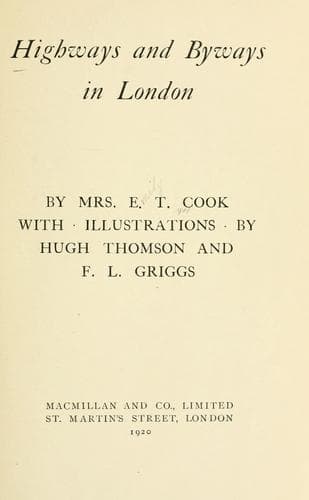
Highways and Byways in LondonCook, Emily Constance Baird
History
Highways and Byways in London
Cook, Emily Constance Baird
London (England) -- Description and travel
The principal reason, of course, for the modern unfashionableness of
Bloomsbury is to be found in its inhabitants; it is, practically, a
city of cheap boarding-houses. It will be interesting to see how the
big new Russell Hotel in Russell-Square will affect these. Though
boarding-houses are vetoed in the big squares, they abound everywhere
else. They are chiefly frequented by Americans and Germans, who,
through the late summer and autumn, throng the streets, generally
discoverable by their red "Baedekers," no less than by their speech.
It is, in fact, in July or August, more common, just here, to hear
German spoken than English. London, it has been ascertained, attracts
now a greater number of tourists than any other place in the world,
and these tourists mostly lodge in Bloomsbury. The theatrical world,
also, lives largely about here--it is so convenient for the theatres;
but it prefers, for its part, private lodgings, or flats. Yet, even
with all this yearly influx from other nations, Bloomsbury is
wonderfully little known to the world of shops or of fashion. Oxford
Circus is only distant ten minutes from the Russell Hotel, yet "where
is Russell Square?" is no uncommon question, even in a shop as big as
Peter Robinson's. "Where is Russell Square?" is, indeed, an almost
classical question; for it was made in so august a place as the House
of Commons, by so omniscient a being as Mr. Croker. It is
crushing--but so it is. You might as well, in the world's eyes, live
at Fulham or Kennington Park. "Why do you live so far away?" is a
question constantly asked of the Bloomsbury resident by people from
distant Battersea or Campden Hill, whom it would be useless to try to
undeceive. "The very absence of any knowledge of this locality," said
a noted wit, "is accounted a mark of high breeding." Among those who
have spoken despitefully of Bloomsbury is Mr. Gladstone. Sir Algernon
West records a conversation about Panizzi, and his "sad, ill days
before his death," "which Mr. Gladstone attributed greatly to the
fact of his living in Bloomsbury Square." But, with all respect to Mr.
Gladstone, it may be submitted that Panizzi would have died anywhere,
while, on the other hand, he could not have lived anywhere except in
his beloved Museum-land. Bloomsbury, too, is Whig territory, and it
was too bad of Mr. Gladstone to identify it with the Inferno.
Its social glory may have passed away from Bloomsbury, but pathetic
little scenes from a lower strata of life daily enact themselves here
before our eyes. For the poor we have, indeed, always with us. Here,
for instance, to a certain humble street corner, has come for many
years an old blind man who sells collar-studs. He arrives punctually
every morning, led along carefully by his wife. Once arrived, his mode
of procedure is always the same.
Public-domain text, read in full here on John Shaqi.
Reviews
Reviews
No reviews yet
Be the first to share your thoughts on this work.
Elsewhere in the archive
Join the Discussion
Join the discussion
Sign in to leave a comment or review.
Sign InorCreate an account