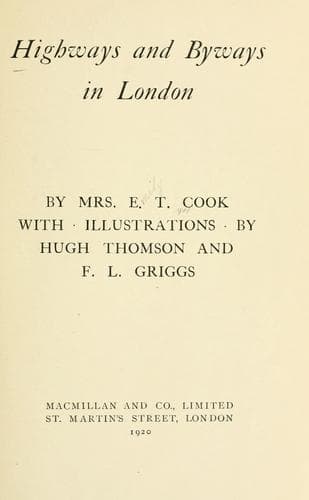
Highways and Byways in LondonCook, Emily Constance Baird
History
Highways and Byways in London
Cook, Emily Constance Baird
London (England) -- Description and travel
If the Rossetti family are deeply connected with Bloomsbury streets
and squares,--William Morris, the poet of _The Earthly Paradise_, the
Socialist, designer, prophet of the House Beautiful, is hardly less
so. It was in unromantic Bloomsbury that his ideas of beauty were
mainly nourished; Oxford Street, Upton, and Kelmscott came later.
Bloomsbury, whose drawing and painting schools are immortalised in
Thackeray's novels (_vide_ "Gandish's," in _The Newcomes_,), has
always been more or less a focus of art teaching. Bohemian in old
days, it is mildly Bohemian still, as any one who frequents the
art-schools of the neighbourhood will testify. When Morris first left
Oxford, in 1856, he and Burne-Jones took rooms together in Upper
Gordon Street, Bloomsbury, as being a convenient locality for the
study of art. Here they fell in with other kindred spirits, such as
Holman Hunt and Rossetti. "Topsy" (Morris) "and I lived together,"
Burne Jones wrote in 1856, "in the quaintest room in all London, hung
with brasses of old knights and drawings of Albert Dürer." In the
following year (1857) they removed to 17 Red Lion Square, a house
already consecrated to the early pioneers of the Pre-Raphaelite
Brotherhood:
"It was a first-floor set of three rooms; the large room in
front looked north, and its window had been heightened up to
the ceiling to adapt it for use as a studio: behind it was a
bedroom, and behind that another small bedroom or powdering
closet. Till the spring of 1859 this was their London
residence and working place, and it is round Red Lion Square
that much of the mythology of Morris's earlier life
clusters. From the incidents which occurred or were invented
there, a sort of Book of the Hundred Merry Tales gradually
was formed, of which Morris was the central figure."--(_Life
of W. Morris, by J. W. Mackail._)
"A great many of these stories are connected with the maid of the
house, who became famous under the name of 'Red Lion Mary.' She was
very plain, but a person of great character and unfailing good
humour.... One of the tales told of her shows her imperturbable good
nature. Rossetti one day, on her entering the room, strode up to her,
and in deep resonant tones, with fearful meaning in his voice,
declaimed the lines:
"'Shall the hide of a fierce lion
Be stretched on a couch of wood
For a daughter's foot to lie on,
Stained with a father's blood?'
"Whereupon the girl, quite unawed by the horrible proposition, replied
with baffling complacency, 'It shall if you like, sir'!"
Public-domain text, read in full here on John Shaqi.
Reviews
Reviews
No reviews yet
Be the first to share your thoughts on this work.
Elsewhere in the archive
Join the Discussion
Join the discussion
Sign in to leave a comment or review.
Sign InorCreate an account