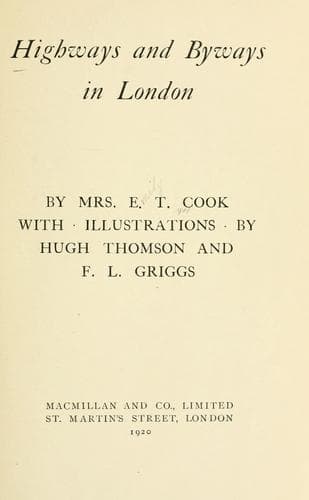
Highways and Byways in LondonCook, Emily Constance Baird
History
Highways and Byways in London
Cook, Emily Constance Baird
London (England) -- Description and travel
That the British Museum is gradually absorbing all the houses near it,
and enlarging its boundaries into a large square, is evident. The
whole eastern side of Bedford Square, and part of the western side of
Russell Square, will soon be amalgamated into the vast building. The
little lions, those ornaments on the old outer railings, about whose
disappearance such an outcry was raised some years back, have been
adapted to the internal use of the Museum, and higher, stronger, more
important railings substituted on the outside in their place. The
large pediment of the portico, imitated--at how long an
interval!--from the Greek model, is, like the statues in the squares,
filled with nesting birds, and is generally also white with the
pigeons' plumage. And, where this enormous building now stands, was
originally Old Montague House, the "stately and ample ancient palace,"
adorned by Verrio and built in the "French pavilion" way, when,
practically, all the rest of Bloomsbury was open country. Where the
big galleries now extend were corridors adorned by fresco paintings:
and where the halls now given up to statues and treasures stand, were
rooms full of light, music, and dancing.
But I am wandering from the present. Yet, in the early winter twilight
of the British Museum galleries, it is easy for vagrant fancies,
unbidden, to arise. The vast dim galleries raise, indeed, ghosts and
visions of a brilliant past, and confer almost humanity on their
marble tenants, gigantic figures shining through the gloom. The Greek
gods of the heroic age,--the creatures "moulded in colossal calm,"--we
can almost imagine the minds who inspired, the workmen who wrought,
the sculptors who fashioned, the temples that contained them. The
stream of life still flows around the feet of these immortal ones, who
in their calm smiling seem to scorn the poor passions of humanity; in
their immortality, to rise above the feeble ebb and flow of human
life. As Aurora they remain ever youthful, while we poor mortals, like
Tithonus, adore their eternal youth and beauty, and ourselves grow
old. Here, in the dim vestibule, is just such a Grecian Urn as that
which Keats apostrophized, with its lovers whose undying youth and
unsatisfied longing he envied.... "Ars longa, vita brevis," indeed! We
go, but they shall endure,--to see "new men, new faces, other minds";
to have, perchance, new labels written for them by future Dryasdusts;
to be invested with fresh attributes by a newer school of ambitious
critics. Many of them have seen cities rise and fall; they have
survived ruin, siege, burial, neglect; and now at last they have come
here to the same dead level of monotony:
"Deemed they of this, those worshippers,
When, in some mythic chain of verse
Which man shall not again rehearse,
The faces of thy ministers
Yearned pale with bitter ecstasy?
Public-domain text, read in full here on John Shaqi.
Reviews
Reviews
No reviews yet
Be the first to share your thoughts on this work.
Elsewhere in the archive
Join the Discussion
Join the discussion
Sign in to leave a comment or review.
Sign InorCreate an account