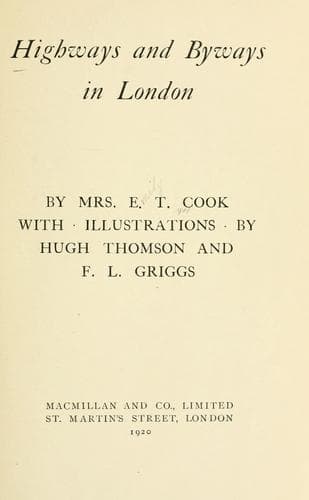
Highways and Byways in LondonCook, Emily Constance Baird
History
Highways and Byways in London
Cook, Emily Constance Baird
London (England) -- Description and travel
The painter-poet, William Blake, with his charming insanity, has left
us glimpses of his strangely warped mind in his mysterious painting of
_Pitt Guiding Behemoth_, which hangs on the walls in another part of
the gallery. The more one looks at this little picture, the more its
green and gold hues and the tongues of its flames have fascination. It
is dark and unattractive at a first glance: but, to show how fatally
easy it is to attract a "following," and also how much in need the
average visitor is of a pilot to the Gallery, one only has to draw up
a chair and seat one's self before this small canvas to collect an
inquisitive crowd. People, even educated people, are strangely
imitative! Besides this picture, there are only one or two minor works
by Blake in our National Gallery. Instead of his _Canterbury
Pilgrims_, we have here that of his contemporary Stothard, who took
the idea from Blake and supplanted him. Stothard's _Canterbury
Pilgrims_ caused a quarrel between himself and Blake; a quarrel which
was never healed; and Blake criticised his rival's painting freely on
its exhibition. Hoppner, the artist, praised it; adding that Stothard
had "contrived to give a value to a common scene, and very ordinary
forms." Thereupon Blake, in criticising the critic, said that this was
Hoppner's only just observation; "for it is so, and very wretchedly so
indeed. The scene of Mr. S.'s picture," he adds, "is by Dulwich hills,
which is not the way to Canterbury; but perhaps the painter thought he
would give them a ride round about, because they were a burlesque set
of scarecrows, not worth any man's respect or care." _Tantæne animis
cælestibus iræ?_
Among the works of the Lombard School is a picture by Parmigiano, _The
Vision of St. Jerome_ (No. 33), which shows how the artist can forget
himself in his work. For Parmigiano was engaged on this very picture,
in Rome, during the German sack of the city in 1527. Vasari says that
the painter was so intent on his work that, even while his own
dwelling was filled with the German invaders, he continued
undisturbed; and that when they arrived in his room and found him so
employed they stood amazed at the beautiful paintings, and wisely
permitted him to continue. Parmigiano's picture is thus, in the truest
sense, historical.
Public-domain text, read in full here on John Shaqi.
Reviews
Reviews
No reviews yet
Be the first to share your thoughts on this work.
Elsewhere in the archive
Join the Discussion
Join the discussion
Sign in to leave a comment or review.
Sign InorCreate an account