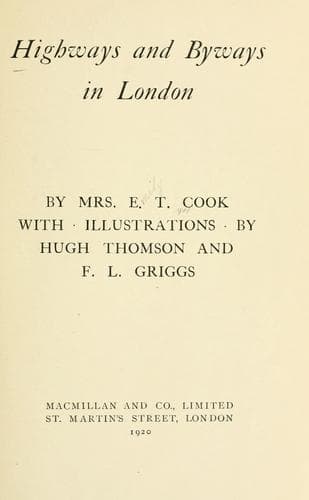
Highways and Byways in LondonCook, Emily Constance Baird
History
Highways and Byways in London
Cook, Emily Constance Baird
London (England) -- Description and travel
"Wrought in the troublous times of Italy
By Sandro Botticelli, when for fear
Of that last judgment, and last day drawn near,
To end all labour and all revelry,
He wept and prayed in silence."
The painting is full of theological symbolism, and its Greek
inscription, being translated, runs: "This, I, Alexander, painted at
the end of the year 1500, in the troubles of Italy, in the half-time
after the time during the fulfilment of the eleventh of St. John, in
the second woe of the Apocalypse, in the loosing of the Devil for
three years and a half. Afterwards he shall be chained, and we shall
see him trodden down, as in this picture." Botticelli had already,
earlier in life, got into religious trouble by his reforming
tendencies. When quite a young man, he had painted, for a Florentine
citizen, Matteo Palmieri, a large picture called _The Assumption of
the Virgin_, which also hangs in our Gallery (No. 1126). Palmieri had
adopted Origen's strange heresy that the human race was an incarnation
of those angels who, in the revolt of Lucifer, were neither for God
nor for his enemies; and, as he and Botticelli, in working out the
design of the picture, had made amendments in theology, they fell into
disgrace. Suspected of heresy, Botticelli's work was covered up; and
the chapel for which it had been painted was closed until the picture
left Florence for the Duke of Hamilton's collection and was bought by
the nation in 1882. "The story of the heresy interprets," Mr. Pater
says, "much of the peculiar sentiment with which Botticelli infuses
his profane and sacred persons, neither all human nor all divine."
Most interesting, too, is Carpaccio's Venetian painting of the Doge
Giovanni Mocenigo (750), which faithfully represents a page of the
history of Venice. The doge is shown kneeling before the Virgin, and
begging her protection, on the occasion of the plague in 1478.
Medicaments and nostrums against the epidemic are contained in a gold
vase on the altar before the throne; and a blessing (according to the
inscription below) is asked on them: "Celestial Virgin, preserve the
City and Republic of Venice, and the Venetian State, and extend your
protection to me, if I deserve it." Simple and modest indeed was
Venice in the good days of her prosperity! Compare with this kneeling,
crownless doge, the new and elaborate frescoes in the Vatican, where
the Pope is represented in his grandest robes, benevolently granting
to the Madonna an audience, with masters of the ceremonies standing
by, and obsequious pages holding his gold-laced train.
Public-domain text, read in full here on John Shaqi.
Reviews
Reviews
No reviews yet
Be the first to share your thoughts on this work.
Elsewhere in the archive
Join the Discussion
Join the discussion
Sign in to leave a comment or review.
Sign InorCreate an account