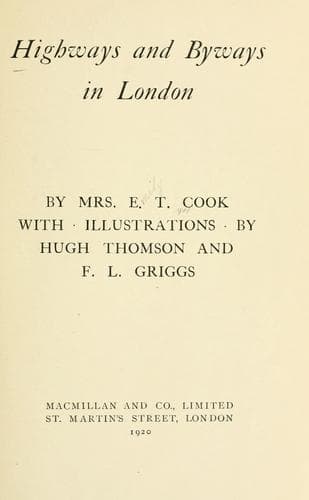
Highways and Byways in LondonCook, Emily Constance Baird
History
Highways and Byways in London
Cook, Emily Constance Baird
London (England) -- Description and travel
Sadder still is the case of those artists whose pictures themselves
have not faded, but the fashion for whose pictures has gone. Sir
Benjamin West, who died some sixty odd years ago, enjoyed very great
fame during his life. He painted many large historical canvases, all
painstaking, and, in their way, of undoubted merit. They gained high
prices in their day, and are now mostly consigned either to cellars or
to the darkest rooms of suburban galleries.
Time is, after all, the greatest of art critics, and its judgment is
sure. The best of all the centuries adorns the walls of the National
Museum. It is the best only that survives. To us, in all our painful
twentieth-century newness, it is given to inherit the mystery and
magic of the old Greeks and Egyptians; the charming imagery of
Raphael, filled with simple faith and sweet imagination; the quaint
beauty of Botticelli, and of the early Florentines, whose art was a
part of their life; the gay voluptuousness of the later Venetians;
"the courtly Spanish grace" of Velasquez; the charming affectations of
Sir Joshua Reynolds, shown in the fair ladies whose portraits, in
their beauty, once filled the halls of England. All is given to us,
unsparingly. For us and for the enrichment of the walls of our
National Gallery, did the rude barbarians, in the sack of Italian
cities, stay the hand of destruction; for us the treasures of art were
wrested from many a palace of antiquity; it was for the delight of
thousands of modern Londoners that the monasteries of the Middle Ages
were plundered. Altar-pieces painted for adoration in the private
chapel of some patron saint are now seen dimly, through London fog and
smoke, hanging, maybe, next to some pagan _Bacchus and Ariadne_, or
_Venus and the Loves_. For our sake were battles fought, to include
masterpieces among the spoils; for us did the Italian nobles sell
their treasures into the hands of money-lenders. Could Botticelli,
that fervent follower of Savonarola, he who "worked and prayed in
silence," have guessed that his beloved _Nativity of Christ_ would,
centuries hence, be removed to barbarous London, and be stared at by
crowds of wondering Philistines, who should see in it only the curious
uncouthness of its gestures,--he would, surely, have held his hand.
Public-domain text, read in full here on John Shaqi.
Reviews
Reviews
No reviews yet
Be the first to share your thoughts on this work.
Elsewhere in the archive
Join the Discussion
Join the discussion
Sign in to leave a comment or review.
Sign InorCreate an account