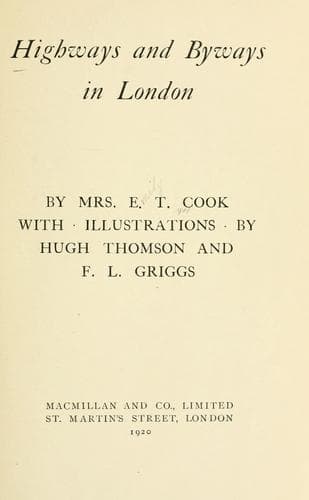
Highways and Byways in LondonCook, Emily Constance Baird
History
Highways and Byways in London
Cook, Emily Constance Baird
London (England) -- Description and travel
Lord Rosebery used 10, Downing Street, for official purposes; Lord
Salisbury did not use it at all. Many historic scenes have been
enacted, and many momentous questions settled, within its walls. It
was in its entrance hall, trodden by the feet of successive
generations of politicians, that Wellington and Nelson met for the
only time in their lives, both waiting to see the Minister, and
neither knowing who the other was. They naturally entered into
conversation, but it was not until afterwards that they knew to whom
they had been speaking. The house itself is solid and substantial,
without any architectural attractiveness, and to the casual observer
suggests nothing different from thousands of other London dwellings.
From the outside, no one would imagine it to be commodious, but it has
some very large apartments; and the old council chamber, the principal
features of which are the book-lined walls, massive pillars, and
heavy, solid furniture, remains much as it was in Walpole's day. Here
many conferences of Ministers have been held, and the most delicate
affairs of State settled. The Cabinet Councils have, however, not
always been held here. Mr. Gladstone preferred to hold them in his own
more cosy room on the floor above; and Lord Salisbury preferred to
hold them at the Foreign Office. Next door is the official residence
of the Chancellor of the Exchequer. The entrance to the Foreign Office
and the Colonial Office is opposite. Which of these great buildings,
with their numerous passages and annexes and waiting-rooms, is the
original of Dickens's "Circumlocution Office," it would be invidious
even to attempt to discover.
Nowhere is the curious unexpectedness of London houses better
exemplified than in the building known as Sir John Soane's Museum, on
the north side of the square called Lincoln's Inn Fields. Here to all
seeming, stands an ordinary dwelling-house;--its front, it is true,
somewhat of the ornate kind,--but utterly misleading, so far as its
outer appearance is concerned, to the passer-by. Nor does the illusion
stop at the hall-door. For there is here an air of homely
friendliness, of quiet welcome, that is altogether at variance with
any preconceived ideas that the visitor may have formed about museums
in general. Several dignified family servants of irreproachable
demeanour lie in wait for the stranger and kindly escort him round. It
is not till you have passed the Rubicon of the double dining-room, yet
arranged exactly as in the lifetime of the founder, that you begin to
realise that you are in a museum, not in a private mansion. And the
realisation is even then difficult, for the family butlers have a
familiar way of alluding to "Sir John," the donor, as though he were
alive and in the next room, thus:
Public-domain text, read in full here on John Shaqi.
Reviews
Reviews
No reviews yet
Be the first to share your thoughts on this work.
Elsewhere in the archive
Join the Discussion
Join the discussion
Sign in to leave a comment or review.
Sign InorCreate an account