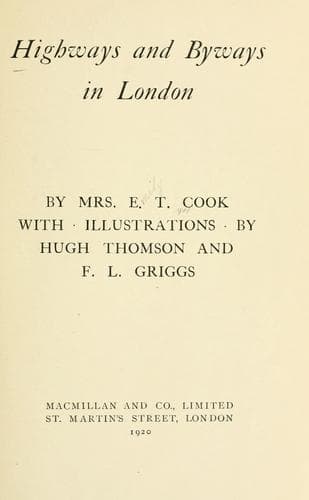
Highways and Byways in LondonCook, Emily Constance Baird
History
Highways and Byways in London
Cook, Emily Constance Baird
London (England) -- Description and travel
There is, at the present time, despite the encroachments of a modern
and generally iconoclastic London, now a wholesome spirit of
veneration abroad, which tends not only towards the preservation of
ancient and historical buildings, but also towards the acquisition of
the homes that have been lived in and made beautiful by the celebrated
men of our own day. Of this kind is "Leighton House," bought since
Lord Leighton's death by the effort of a private committee, and now
opened free to the nation. The rooms and internal arrangement are, as
in the case of the "Carlyle House," left as nearly as possible in
their original condition, and though of necessity much of the valuable
furniture and accessories have been removed, yet the many sketches and
drawings illustrative of the painter's life-work that fill the walls
do something to dispel the unavoidable sense of incompleteness. It is
interesting to wander through the beautifully-proportioned rooms, to
gaze into the well-tended, sun-lit garden, with its gay geranium beds
and its green lawn; to sit in the mysterious semi-darkness of the
"Arab Hall," and look up into its gold-encrusted dome; to listen to
the mournful splash of the tiny fountain in its marble basin;--and
yet, "wanting is--what?"
"When the lamp is shattered
The light in the dust lies dead."
It will always be a question how far the mere dwelling of a great
painter is worth thus preserving in its integrity, when once the magic
of his presence, his genius, has deserted it, and the growing work of
his art no longer adorns its walls. The committee of the "Leighton
House" have done their work with judgment and care, and, if the
inevitable comparison occurs to those who saw it in the life time or
during the "show days" of its late master, of former life and
splendour with present gloom and sadness, this is only in the nature
of things. The blue tiles that the painter loved still adorn, in
bird-of-paradise like splendour, the wide, massive staircase; the
water still tinkles in the Pompeian atrium as of old; and the master's
art can still be studied in the many drawings and reproductions that
fill, so far as they can, the places left by greater works.
Hertford House, in Manchester Square, the sumptuous home of the
Wallace collection, bequeathed to the nation by Lady Wallace in 1898,
is the most important of the nation's artistic legacies. Though in a
sense historic--for it is the "Gaunt House" of _Vanity Fair_, and its
former owner, Lord Hertford, was caricatured as the Marquis of
Steyne;--yet, as it is mainly as a picture gallery that it must be
noticed, it has fallen most conveniently into a previous chapter.
Public-domain text, read in full here on John Shaqi.
Reviews
Reviews
No reviews yet
Be the first to share your thoughts on this work.
Elsewhere in the archive
Join the Discussion
Join the discussion
Sign in to leave a comment or review.
Sign InorCreate an account