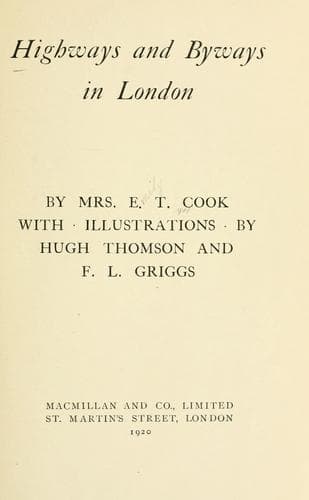
Highways and Byways in LondonCook, Emily Constance Baird
History
Highways and Byways in London
Cook, Emily Constance Baird
London (England) -- Description and travel
Ghosts of our own fancy may, and do, wander at their will in London's
misty galleries; but ghosts, better authenticated, are popularly
supposed to haunt a few of London's old houses. Thus, No. 50, in
Berkeley Square has gained undesirable notoriety as the "Haunted
House," and many extraordinary tales have from time to time been told
as to its ghostly manifestations. Berkeley Square has, undeniably, a
solid and old-time look that fits in well with the gloomy tradition;
it has the best and most ancient plane-trees of any London square, and
its fine old iron-work, with occasional torch-extinguishers (used by
the "link-boys" of sedan chairs in Stuart times), are all in keeping
with the old-world spirit. Nevertheless, Berkeley Square has other and
sadder associations than those of mere ghosts. For in No. 45,--a house
specially noted for its iron-adornments,--the great Lord Clive,
founder of the British Empire in India, committed suicide in 1774. "In
the awful close," says Macaulay, "of so much prosperity and glory,"
some men only saw the horrors of an evil conscience; but Clive from
early youth had been subject to "fits of strange melancholy," while
now his strong mind was sinking under physical suffering, and he took
opium for a distressing complaint.
In Berkeley Square (No. 38) is the town house of Lord Rosebery, once
the residence of Lady Jersey, and the place whence her mother,--the
daughter of Child, the banker,--eloped to marry the Earl of
Westmorland, in 1782.
It were, however, an invidious, as well as an impossible task, to name
all London's historic houses. What street in London is, indeed, not
"historic" in a sense? Houses may be pulled down, but even thus their
locality knows them still. Is not even Turner the painter's squalid,
dirty house in Queen Anne Street, now razed, yet recalled to the
passer-by, by the tablet affixed to the houses that have since sprung
up on its site? "Unlovely" Wimpole Street is sacred to the shade of
Elizabeth Barrett Browning, that "small, pale person, scarcely
embodied at all." It was from this house, No. 50, that she wrote her
impassioned love-letters, and, after years of chronic invalidism, ran
away, secretly and romantically, to marry a brother-poet. The
picturesque chambers known as "the Albany,"--a byway out of
Piccadilly,--recall Lord Macaulay, Lord Byron, Lord Lytton. Curzon
Street suggests the famous parties, in the early nineteenth century,
of the sisters Mary and Agnes Berry, the friends of Horace Walpole. In
Soho,--a district famous in old days for an artistic, and
semi-Bohemian fraternity, whose houses emulated Turner's in
dirt,--lived the painters Northcote, Mulready, Fuseli, Stothard,--and
Flaxman the sculptor. At 28, Poland Street, lived William Blake, the
poet-painter, the half-crazy, but wholly charming, seer and mystic;
here he wrote his _Songs of Experience_ and of _Innocence_, and drew
his _Visionary Portraits_. (The story of Blake and his wife, "reciting
Public-domain text, read in full here on John Shaqi.
Reviews
Reviews
No reviews yet
Be the first to share your thoughts on this work.
Elsewhere in the archive
Join the Discussion
Join the discussion
Sign in to leave a comment or review.
Sign InorCreate an account