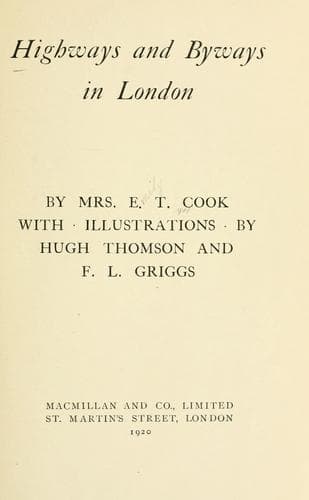
Highways and Byways in LondonCook, Emily Constance Baird
History
Highways and Byways in London
Cook, Emily Constance Baird
London (England) -- Description and travel
The old church is, like all London churches, dark, and it requires a
bright day to be thoroughly appreciated. Lady sketchers are sometimes
to be seen there, their easels set up in secluded nooks. The church,
however, is generally more or less desolate, a curious little island
of quiet after the surrounding din of the streets and alleys. Perhaps
one or two strangers,--Americans most likely,--men by preference,--may
be seen going over it; but old city churches do not, as a rule,
attract crowds of visitors. Passers-by can rarely direct you to them,
and even dwellers in the district can but seldom tell you where they
are. For cockneys, even "superior" cockneys, are born and die in
London without ever troubling themselves over the existence of these
ancient relics of the past. Yet, if the natural beauties of St.
Bartholomew are great, greater still is its historical interest. The
vandalisms of the Reformation, and, later, of the Protectorate, have
fortunately spared most of its ancient monuments, and the tomb of
Rahere, the founder and earliest prior, shows its recumbent effigy
still uninjured under a vaulted canopy. The tomb is on the north side
of the choir, just inside the communion rails. Though the canopy is
admittedly the work of a fifteenth-century artist, the effigy is said
to belong to Rahere's own time. The founder is represented in the
robes of his Order (the Augustinian Canons); his head has the monkish
tonsure; a monk is on each side of him, and an angel is at his feet.
The effigy, like several other monuments in the church, has been
darkened all over, probably by the misplaced zeal of Cromwellian
iconoclasts, with sombre paint; this coating, however, has been to a
great extent removed. (In some of the other tombs and monuments the
darkening is done with some thick black pigment, impossible entirely
to remove.) The Latin epitaph on Rahere's tomb is simple:
"Hic jacet Raherus primus canonicus et primus prior hujus
ecclesiae."
Some twenty years ago the tomb was opened, and Rahere's skeleton
disclosed, together with a part of a sandal, which latter may be seen
in a glass case among other relics in the north transept.
Almost opposite the founder's tomb, looking down from the south
triforium, is Prior Bolton's picturesque window, built by him
evidently for the purpose of watching the revered monument. Prior
Bolton, the most famous of Rahere's successors, ruled the convent from
1506 to 1532; his window is a projecting oriel, and on a middle panel
below is carved his well-known "rebus," a "bolt" passing through a
"tun"; this rebus occurs also at other places in the church.
Public-domain text, read in full here on John Shaqi.
Reviews
Reviews
No reviews yet
Be the first to share your thoughts on this work.
Join the Discussion
Join the discussion
Sign in to leave a comment or review.
Sign InorCreate an account