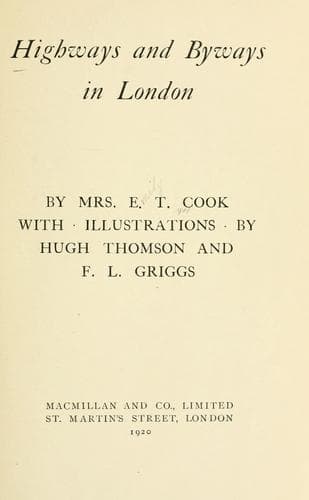
Highways and Byways in LondonCook, Emily Constance Baird
History
Highways and Byways in London
Cook, Emily Constance Baird
London (England) -- Description and travel
The splendid alabaster tomb of Sir Walter Mildmay, a statesman of
Queen Elizabeth's day, and founder of Emmanuel College, Cambridge,
should be noticed in the south ambulatory. The vandalism of former
times had, curiously enough, not blackened this tomb, but endued its
alabaster with an upper coating of sham marble--now removed. The
remainder of the tombs and monuments will all repay inspection; and
some of the inscriptions are very quaint. For instance, in a bay in
the south ambulatory is a monument to a certain John Whiting and his
wife, with the verse (nearly defaced) from Sir Henry Wotton:
"Shee first deceased, he for a little try'd
To live without her, lik'd it not and dy'd."
And in another place is the monument to Edward Cooke, "philosopher and
doctor," which is made of a kind of porous marble that exudes water in
damp weather, and has inscribed on it the following appropriate
epitaph:
"Unsluice, ye briny floods. What! can ye keep
Your eyes from teares, and see the marble weep?
Burst out for shame; or if ye find noe vent
For teares, yet stay and see the stones relent."
Yet the marble was not altogether to be blamed. It is sad to spoil a
poetic illusion; but it seems that in old days the church was damp, so
damp that the rector--if report is to be believed--had to preach
sometimes under an umbrella, and the marble "wept" abundantly. Now,
however, that the building is repaired and properly warmed, the
"stones relent" no more.
St. Bartholomew has had, too, its quota of famous parishioners.
Milton, that constant though wandering Londoner, lived close by at one
time, in his "pretty garden-house" of Aldersgate (that garden-house
that was yet so dull that his young wife ran away temporarily both
from it and him!); and the poet probably attended divine service in
the church. Hogarth, the painter, was baptised here, as the parish
registers tell. The congregation of the present day, however, comes,
as is so often the case with old city churches, mainly from outside.
The immediate neighbourhood is hardly church-going, being a
collection of narrow alleys and mysterious courts. And yet, in these
dark purlieus of "Little Britain," house-room is frightfully dear, and
in the crumbling tenements of "Cloth Fair," a poor room costs about
6_s._ per week. As to the population, only fifteen years ago they were
rough, rowdy, even criminal in places; now, however, the district is
mainly respectable, although overcrowded by workers--factory hands,
private manufacturers, widows who work in City offices and who cling
to the locality as being near and convenient. It is very difficult for
the authorities to obviate overcrowding in certain central London
districts. Little Britain, now devoted to warehouses and tenement
dwellings, was in old days filled with book-shops; indeed, the whole
district used to be literary, for Milton Street, near by, was the
"Grub Street" of Pope's obloquy in the _Dunciad_. In Little Britain
Public-domain text, read in full here on John Shaqi.
Reviews
Reviews
No reviews yet
Be the first to share your thoughts on this work.
Join the Discussion
Join the discussion
Sign in to leave a comment or review.
Sign InorCreate an account