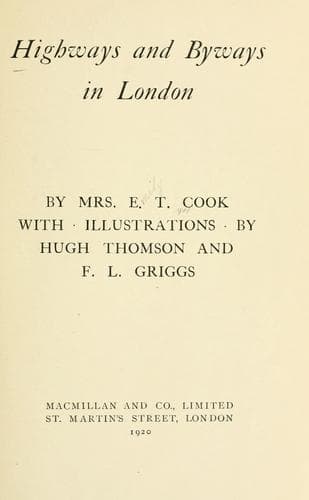
Highways and Byways in LondonCook, Emily Constance Baird
History
Highways and Byways in London
Cook, Emily Constance Baird
London (England) -- Description and travel
But St. Bartholomew's precincts are not the only "haunts of peace" in
this noisy neighbourhood. Crossing the Metropolitan Meat Market, and
picking your way northward, through innumerable ugly tram-lines, you
presently reach the quiet and restful Charterhouse Square, whence,
through an archway, the precincts of the ancient monastery are
entered. Charterhouse Square, once an enclosure of seventeenth-century
palaces, is a delightful old place even yet; though its sober
residential look of time-darkened red brick is now but a blind, and it
is rapidly becoming a square of hotels and lodging-houses. Such a fate
was, of course, inevitable in its case; and yet it seems mournful. The
spot where Rutland House, the ancient residence of the Venetian
ambassador, once stood, is only commemorated now in the name of
Rutland Place. The City palaces have crumbled; they have all been
rebuilt in the far West; and even Bloomsbury has none left, except
those which are devoted to the modern flat! One of the prettiest
houses now to be seen in the present Charterhouse Square,--its front
trellised over with bright Virginian creeper, such a house as Miss
Thackeray loved to describe,--is now a "home" fitted up by a big city
warehouse for the accommodation of its working girls. The square
garden is still nicely kept; Janus-faced, it looks on to the world's
noisy mart on the one side, and, on the other, towards conventual
peace.
But you must not linger in Charterhouse Square; time is passing, and
the archway leading to the ancient sanctuary invites you. The
guide-books tell you that this archway is in the "Perpendicular"
style; that its projecting shelf above is supported by lions; this
and much more; but you do not always feel in a mood to digest
guide-books. They are so aggressive in their information, and so
distracting to one's own thoughts! For, how many associations does not
this classic abode recall! You can easily imagine groups of tonsured,
cowled friars, standing here and there in the shadows of the
quadrangles; one "grey friar" of a later time, with "the order of the
Bath on his breast," perhaps, most of all.
This Carthusian monastery, so powerful in mediæval times, and founded
by Sir Walter Manny as early as 1321, was suppressed by the rapacity
of Henry VIII., that brutal though necessary reformer. The story of
the dissolution is a cruel and heartrending one. Prior Houghton, the
last superior of the monastery, protested against the king's
spoliation of Church lands; he was promptly convicted of high treason,
and, with several of his monks, was "hanged, drawn, and quartered" at
Tyburn. They died gallantly, and in their deaths we revere that true
and sturdy spirit that still in our own day leads England on to glory:
Public-domain text, read in full here on John Shaqi.
Reviews
Reviews
No reviews yet
Be the first to share your thoughts on this work.
Elsewhere in the archive
Join the Discussion
Join the discussion
Sign in to leave a comment or review.
Sign InorCreate an account