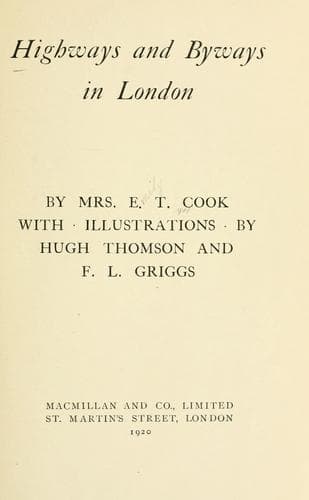
Highways and Byways in LondonCook, Emily Constance Baird
History
Highways and Byways in London
Cook, Emily Constance Baird
London (England) -- Description and travel
"If" (says Froude) "we would understand the true spirit of
the time, we must regard Catholics and Protestants as
gallant soldiers, whose deaths, when they fall, are not
painful, but glorious; and whose devotion we are equally
able to admire, even where we cannot equally approve their
cause. Courage and self-sacrifice are beautiful alike in an
enemy and in a friend. And while we exult in that chivalry
with which the Smithfield martyrs bought England's freedom
with their blood, so we will not refuse our admiration to
those other gallant men whose high forms, in the sunset of
the old faith, stand transfigured on the horizon, tinged
with the light of its dying glory."
Prior Houghton's bloody arm, severed from his murdered corpse, was
hung up over the gateway of his sanctuary, to awe his remaining monks
into obedience; while his head was exposed on London Bridge. Brutal,
indeed, were our forefathers of the Tudor time!
The Charterhouse, after the banishment and death of its monks, passed
through the hands of several of the king's favourites, and came
eventually into those of the Duke of Norfolk, who altered it
considerably, making it less monastic and more palatial in character.
But a new era of usefulness awaited the ancient convent; better days
for it were at hand. For it was finally sold by the Norfolk family to
one Thomas Sutton, a rich and philanthropic Northumbrian coal-owner,
who converted it into a "Hospital" for eighty poor men, and a school
for forty poor boys. The school, so picturesque in Thackeray's
_Newcomes_, no longer exists here as in old days; in 1872, the modern
craze for fresh air transferred it to new premises at Godalming; and
the boys' vacated buildings were sold to the Merchant Taylors' Company
for their own school. The almshouses for the poor brothers remain,
however, just as they were. Times change, and, though the aged
bedesmen are yet poor, it is doubtful whether all the boys who benefit
from the foundation, can still be called so. The school, like other
foundations of its kind, probably now benefits a higher class than old
Thomas Sutton intended.
Many noted men have been pupils of the Charterhouse; Thackeray,
especially, has immortalised his old school in his touching
description of "Founder's Day"; when old Colonel Newcome, in his turn
both pupil and poor brother, sits humbly among the aged pensioners,
clad in his black gown:
"I chanced to look up from my book towards the swarm of
black-coated pensioners: and amongst them--amongst
them--sate Thomas Newcome. His dear old head was bent down
over his prayer-book; there was no mistaking him. He wore
the black gown of the pensioners of the Hospital of Grey
Friars. His order of the Bath was on his breast. He stood
there amongst the poor brethren, uttering the responses to
the psalm.... I heard no more of prayers, and psalms, and
sermon, after that."
Public-domain text, read in full here on John Shaqi.
Reviews
Reviews
No reviews yet
Be the first to share your thoughts on this work.
Elsewhere in the archive
Join the Discussion
Join the discussion
Sign in to leave a comment or review.
Sign InorCreate an account