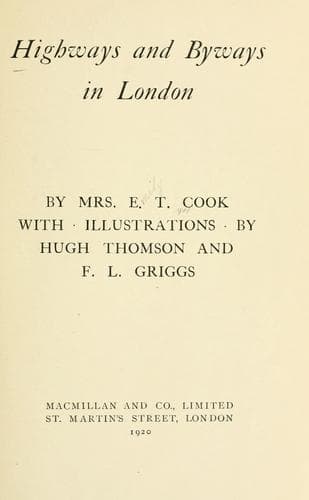
Highways and Byways in LondonCook, Emily Constance Baird
History
Highways and Byways in London
Cook, Emily Constance Baird
London (England) -- Description and travel
A ramble down Bishopsgate, in the inconsequent way already suggested,
will be found thoroughly enjoyable; though it has, of course, the
defect of being exceptionally easy of accomplishment. For this
purpose, an omnibus to the Mansion House will land you exactly where
you want to be. I may add that it is very important to choose a fine
day for the excursion, a day when those imposing golden letters on the
Royal Exchange--the "Anno Elizabethae" and "Anno Victoriae"--glitter
like so many suns above the unceasing whirlpool of human life and
energy below. Have you ever thought, as you looked on those golden
letters, how interesting they may prove to some future antiquary? Like
the "M. Agrippa Cos Tertium Fecit" on the Roman Pantheon, they tell,
proudly, of the glory of a great nation. It is noteworthy that the
names of two queens should here represent England's highest fame, and
commemorate thus, in close juxtaposition, the Elizabethan and
Victorian Age.
The Victorian Age, however, with its bustle and movement, is very much
with us as we approach Bishopsgate along the route of Holborn Viaduct.
If you elect to travel on the top of an omnibus, you will find that
Newgate Street and Cheapside show, in turn and on each side, a
scintillating kaleidoscope of light and colour. Rambles are all very
well in their way; but, under some circumstances, Mr. Gladstone's
dictum was a right one; the top of an omnibus is a wonderful point of
view. So we will go on a 'bus to the Mansion House, and ramble
afterwards. First comes St. Paul's, its imposing dome rising
majestically in ponderous blackness through its surrounding greenery;
then the gloomy walls of grim Newgate prison; next, the pale,
ghost-like spire of St. Mary-le-Bow, shining over its blackened base
and the many-coloured street vista below, and, finally, the great
civic buildings of the City proper, forming in the sunlight, a sort of
white-and-golden circle, a central focusing point of colour and
energy, whence diverge, like so many wheel-spokes, all the great
business thoroughfares. The stranger, set down here for the first
time, generally completely loses his bearings, and even the practised
Londoner sometimes finds himself at a loss. (In a "London particular"
he may even find himself in a very Inferno.) But the cool inner
courtyard of the Royal Exchange, sought as a refuge, will speedily
restore his disordered faculties, and give him time to get out his
pocket-map. Here, let into the inner wall of the colonnade, are modern
paintings of scenes in the history of London by eminent artists, among
which the contrasted pictures of the two great queens (respectively by
Ernest Crofts and R. W. Macbeth) carry out something of the feeling
suggested by the gold-lettered pediment. Elizabeth, on a spirited
charger, golden-haired and in picturesque sixteenth century dress,
opens Sir Thomas Gresham's earlier building; Victoria, a slim girlish
figure, standing between the "great Duke" and Prince Albert,
Public-domain text, read in full here on John Shaqi.
Reviews
Reviews
No reviews yet
Be the first to share your thoughts on this work.
Elsewhere in the archive
Join the Discussion
Join the discussion
Sign in to leave a comment or review.
Sign InorCreate an account