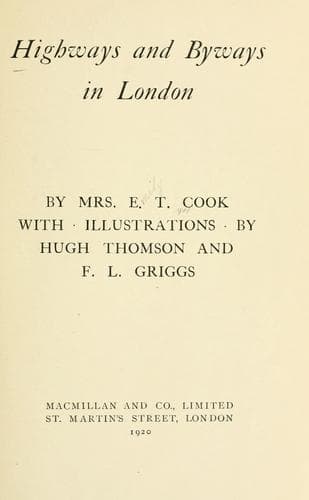
Highways and Byways in LondonCook, Emily Constance Baird
History
Highways and Byways in London
Cook, Emily Constance Baird
London (England) -- Description and travel
There has from immemorial times been a church here; tradition even
suggests a Roman temple on the site. But, though the "spirit" has ever
been constant, the "letter" (so to speak), has often changed. At any
rate Wren's masterpiece is the third Christian church, dedicated to
St. Paul, erected here since early Saxon times. Though Wren's
life-work was not rewarded, like Milton's, with "twenty pounds paid in
instalments, and a near approach to death on the gallows," yet he,
too, had but scant justice in his day. National benefits, even in our
own time, are often but ill rewarded. Thwarted, wretchedly paid,
suspected, and finally, at great age, and after forty-five years' hard
service, deposed from the post he had so long and so ably filled; the
"Nestor" of his age, with a spirit worthy of a more enlightened time,
betook himself cheerfully to his old study of philosophy, and only
once in every year, we are told, indulged his master-passion by having
himself carried to St. Paul's to gaze in silence on his life-work.
[Illustration: _St. Paul's from the River._]
The highest point of the city would, naturally, from very early times
be chosen as the sanctuary; and St. Paul's stands grandly on the top
of Ludgate Hill, its western portico almost facing the steep street of
that name. That it does not do so more exactly, is due to the haste of
the people in rebuilding their houses after the Great Fire; such haste
occasioning the reconstruction of the city more on the old lines, than
on those of Wren. For the great cathedral took some thirty-five years
to complete, and streets grow again more quickly than edifices
destined for the monuments of nations. And, before the new church
could be begun, the useless ruins of its predecessor had to be
removed. The Great Fire had calcined its stones and undermined the
safety of its walls. Such, indeed was the devastation of this terrible
holocaust, that even to this day, its relics and débris may be traced
in distinct thin layers, at certain distances under the soil, all over
the area of the City. The ruin can hardly be imagined, even from
Pepys's and Evelyn's vivid diaries. Small wonder indeed, that it
should be thought by the credulous that the end of the world, the Last
Judgment, had truly come. Some, later, held that the "purification" of
the old church by fire had been the one thing needed after its
desecration in the Commonwealth times to a house of traffic and
merchandize, even sometimes to a stable. The church had become a mere
promenade; "Paul's Walkers" had been the names given to loungers in
the sacred edifice; gallants using it as a place of pastime, beggars
as a resting-place, and Inigo Jones's beautiful portico at the west
end being all built up with squalid shops. The people were gradually
awakening to a sense of these enormities: had cleared out those unholy
traffickers;--were, indeed, in process of restoring the church,--when,
in 1666, the fire came to complete the purification. Then, when the
Public-domain text, read in full here on John Shaqi.
Reviews
Reviews
No reviews yet
Be the first to share your thoughts on this work.
Elsewhere in the archive
Join the Discussion
Join the discussion
Sign in to leave a comment or review.
Sign InorCreate an account