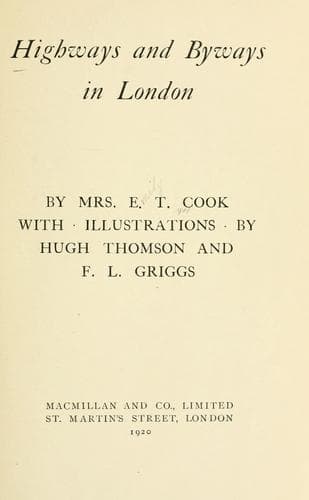
Highways and Byways in LondonCook, Emily Constance Baird
History
Highways and Byways in London
Cook, Emily Constance Baird
London (England) -- Description and travel
More than two centuries have now elapsed since the first opening of
the new St. Paul's for service, and these two centuries have
established, as time alone can do, the fame and the genius of Wren.
Time here, as ever, has delivered the final verdict. The great
cathedral dominates the City, harmonising, ennobling, purifying the
serried mass of its surroundings; it is the coping-stone of London's
greatness. The verdict of later times has done justice to Wren's
judgment, and many of his intentions regarding the details of the
edifice, thwarted in his lifetime by ignorant contemporaries, have now
been carried out. Thus, the organ has been moved from its former place
over the iron-wrought screen between choir and nave, (where it marred
the architectural effect of the edifice), to the north-east arch of
the choir, the position originally planned for it by Wren; the tall
outside railing of the churchyard, which, Wren said, dwarfed the base
of the cathedral, has been removed; the mosaics he asked for now
incrust, in shining glory, the central dome; and, if the grand
"baldacchino" he wanted has not been placed in the choir, there is,
instead, a very sumptuous modern reredos. The balustrade that
surmounts the main building was not intended by Wren, but insisted on
by the Commissioners for the building; and its erection caused Wren to
say, not, perhaps, without sly intention: "I never designed a
balustrade; but _ladies think nothing well without an edging_."
This, however, was long ago; Wren sleeps in peace in his cathedral
crypt; and there, on the top of Ludgate Hill, St. Paul's stands,
blackening ever, year by year, yet gaining immeasurably through that
very blackness. It has been said, wittily, that the great church has a
special claim to its livery of smoke, for the reason that a great part
of the cost of its building was defrayed by a tax on all coals brought
into the port of London! And this canopy of solemn black, out of which
the dome, lantern, and golden ball emerge at intervals, in silver and
gold, becomes it well.
"There cannot," wrote Hawthorne, "be anything else in its
way so good in the world as just this effect of St. Paul's
in the very heart and densest tumult of London. It is much
better than staring white; the edifice would not be nearly
so grand without this drapery of black."
The ancient monuments of St. Paul's were nearly altogether destroyed
with the old church; Wren's cathedral was inaccessible to any new
monuments for some years, the first admitted to it being that of John
Howard the philanthropist in 1790. This was followed by many others,
chiefly of great warriors, soldiers and sailors; although
ecclesiastics also are numerous, and there is a goodly company of
painters.
Public-domain text, read in full here on John Shaqi.
Reviews
Reviews
No reviews yet
Be the first to share your thoughts on this work.
Elsewhere in the archive
Join the Discussion
Join the discussion
Sign in to leave a comment or review.
Sign InorCreate an account