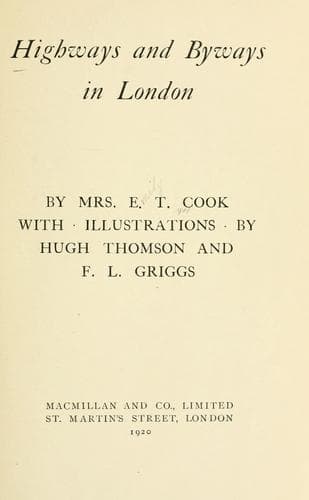
Highways and Byways in LondonCook, Emily Constance Baird
History
Highways and Byways in London
Cook, Emily Constance Baird
London (England) -- Description and travel
In the crypt are the half-destroyed remains of monuments from the
older church, with Nelson's sarcophagus, Wren's simple tomb, and many
others. But, outside St. Paul's, the sunlight still calls us, and,
from the depths of the dim recesses and aisles of the great cathedral,
we regain now the brilliant summit of Ludgate Hill, brilliant with the
noonday spring sun. Now the sounds of many-sided life invade the
repose of death; and a noisy street-organ, playing near Queen Anne's
statue, mingles its note strangely with the cathedral's still pealing
bells. The pigeons, gay in colour, flit down from their homes in among
the blackened garlands, Corinthian capitals, and pediments; it is a
strange and a motley scene. And, down at the bottom of the great
flight of steps that lead from the western portico, the
Twentieth-century visitor will now see a new landmark; for here, cut
deeply into the pavement, is the record of the latest great ceremonial
function of St. Paul's: Queen Victoria's visit here on the sixtieth
anniversary of her reign. Here, on this very spot, surrounded by
Archbishops, priests, and people, the royal and aged lady sat in her
carriage, paying homage to a Heavenly Throne, and receiving, surely,
greater homage than was ever before paid to an earthly one:--
"On a lovely June morning, in the year 1897, a wondrous
pageant moved through the enchanted streets of London.
Squadron by squadron, and battery by battery, a superb
cavalry and artillery went by--the symbol of the fighting
strength of the United Kingdom. There went by also troops of
mounted men, more carelessly riding and more lightly
equipped--those who came from Canada, Australia, New
Zealand, and South Africa to give a deeper meaning to the
royal triumph; and black-skinned soldiers and yellow, and
the fine representatives of the Indian warrior races.
Generals and statesmen went by, and a glittering cavalcade
of English and Continental princes, and the whole procession
was a preparation--for what? A carriage at last, containing
a quiet-looking old lady, in dark and simple attire; and at
every point where this carriage passed through seven miles
of London streets, in rich quarters and poor, a shock of
strong emotion shot through the spectators, on pavement and
on balcony, at windows and on housetops. They had seen the
person in whom not only were vested the ancient kingdoms of
England, Scotland, and Ireland, but who was also at once the
symbol and the actual bond of union of the greatest and most
diversified of secular empires."[1]
[Footnote 1: _Imperium et Libertas_, by Bernard Holland.]
The inscription, cut, with Roman simplicity, into the broad
paving-stone, runs thus:
HERE QUEEN VICTORIA
RETURNED THANKS TO
ALMIGHTY GOD FOR THE
SIXTIETH ANNIVERSARY
OF HER ACCESSION.
JUNE 22, A.D. 1897.
Public-domain text, read in full here on John Shaqi.
Reviews
Reviews
No reviews yet
Be the first to share your thoughts on this work.
Elsewhere in the archive
Join the Discussion
Join the discussion
Sign in to leave a comment or review.
Sign InorCreate an account