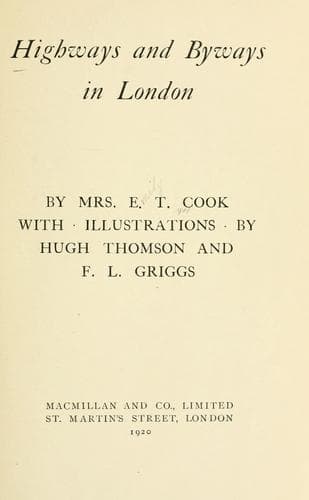
Highways and Byways in LondonCook, Emily Constance Baird
History
Highways and Byways in London
Cook, Emily Constance Baird
London (England) -- Description and travel
Round about St. Paul's are many and labyrinthine lanes and alleys,
with no less labyrinthine associations. Some of these alleys are, like
Paternoster Row, or St. Paul's Churchyard, by day crowded aortas of
human traffic; others, by strange contrast, are silent and still as
the grave. London is, as we know, full of unexpected nooks of quiet;
and none, in their way, are more sudden and startling than those about
St. Paul's. From busy Paternoster Row, with its array of religious
book-shops of all denominations,--so crowded, and yet so narrow, that
a man on one of its sidewalks can, by stretching, almost grasp the
hand of a man on the other (or could perhaps do so, were it not so
constantly blocked by multifarious traffic),--from noisy Paternoster
Row to the calm of "Amen Court,"--the quadrangle of canons' residences
opening out of it,--what a change! Here, in Amen Court, entered by a
pleasant, sober red-brick gateway, Canon Liddon's last days were
spent; here are quiet, old-fashioned houses looking, in summer, on to
green plots and refreshing shrubs. All this seclusion, and yet the
very heart of London! Warwick Square, close by, is a haven of another
sort; a stony square set round with tall offices; roomy houses,
perhaps formerly residential mansions, with here and there an
attractively carved antique porch, or other relic of the past. It was
under a house in this square, in rebuilding, that various Roman
remains were recently found. In Paternoster Row, at the corner of
"Chapter-house Court," was, in old days, the "Chapter" Coffee House,
where the old medical club of the "Wittenagemot" was held, and where,
later, Charlotte and Anne Brontë came on their first visit to London,
after the successful publication of _Jane Eyre_, to make their real
personalities known to their publishers, in 1848. Two little lonely,
strangely-dressed women they must have seemed!--their only friend the
elderly waiter of the establishment, who no doubt, took an interest in
such unusual visitors. Yet, what excitement must they not have felt in
seeing, for the first time, all that they had read and dreamed of for
years! One is reminded of the story of their brother Branwell, that
unhappy child of genius and temptation, who, at lonely Haworth
Parsonage, knew all "the map of London by heart" without ever having
been there, and who could direct any chance stranger who happened,
going Londonwards, to put up at the remote Yorkshire inn.
"Panyer Alley," the last entry leading into Newgate Street,
commemorates the bakers' basket-makers, or "Panyers," of the
fourteenth century. Here, built into the wall of a modern house and
nearly obliterated, was, till quite recently, a relief of a boy
sitting on a "panyer," with this curious inscription:
"When Ye have sought
The Citty Round
Yet still This is
The Highest Ground
Avgvst the 27
1688."
Public-domain text, read in full here on John Shaqi.
Reviews
Reviews
No reviews yet
Be the first to share your thoughts on this work.
Elsewhere in the archive
Join the Discussion
Join the discussion
Sign in to leave a comment or review.
Sign InorCreate an account