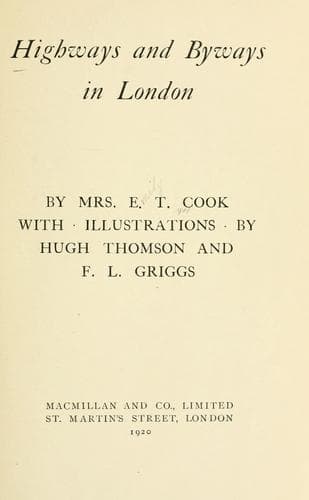
Highways and Byways in LondonCook, Emily Constance Baird
History
Highways and Byways in London
Cook, Emily Constance Baird
London (England) -- Description and travel
Yet I myself think that it is a pity to treat the classic Tower on
such familiar terms! It should be approached with respect, and not
merely introduced as a juvenile appendix to Madame Tussaud's! The
charm of the old fortress, as of its immediate surroundings, is, in
any case, only realised in maturer years. This has always been the
riverside stronghold of London. Tradition, and poetic license, name,
indeed, Julius Cæsar as its founder; however that may be, the Romans
probably had a fort here, as Saxon Alfred after them. The White Tower,
or Keep, raised by William the Conqueror, is built upon a Roman
bastion; and Roman relics have been dug up at intervals in its near
precincts. Nevertheless, the Roman tradition here is but visionary;
the interest of the Tower is bound up with the evolution of the
English race. It is the most interesting mediæval monument that we
possess, a still vivid piece of English history; a stranded islet of
Time, left forgotten by the raging tide of surrounding London.
In the Tower precincts,--if you are careful not to choose a Monday or
Saturday, which are free days, for your visit--you may enjoy yourself
in your own way and to your heart's content. The warders,--old
soldiers,--are pleasant and unobtrusive people, with manners of really
wonderful urbanity, considering the very mixed, and generally
unwashed, character, of a large portion of their public. The Tower,
apart from the charm of its lurid and romantic history, is a
picturesque place. In winter, it is somewhat exposed to the elements,
and in summer, owing to its proximity to the Temple of the Fisheries,
it is perhaps a trifle odoriferous; but on a fine spring or autumn
morning,--a spring morning uncursed by east wind, an autumn morning
undimmed by river-mist,--you will realise all the beauty, as well as
the interest, of the place. Part of its attraction lies in the fact
that it is neither a ruin nor a fossil; it is a living place still,
and serves for use as well as for show. In old days by turn palace,
state prison, inquisition, and "oubliette," it is now a barrack and
government arsenal. Its threatening ring of walled towers, witnesses
of so many scenes of blood and cruelty, re-echo now to the merry
voices of little School-Board boys, playing foot-ball in the drained
and levelled moat below; its paved courts and gravelled enclosures
still ring to the tramp of soldiers' feet, but soldiers of a newer and
a more humane era. In days when men suffered cheerfully for faith's
sake, when queens and princes passed naturally to the throne through
the blood of their nearest relations, when self-denial, conscience,
and uprightness of life were reckoned as crimes, the Tower was the
place of doom and death. Here, not only political plotters and state
prisoners, guilty of "high treason," were punished, but also children,
young men and maidens, playthings of an unkind fate, were condemned,
unheard, to an early death. Here, also, at the Restoration, perished,
Public-domain text, read in full here on John Shaqi.
Reviews
Reviews
No reviews yet
Be the first to share your thoughts on this work.
Elsewhere in the archive
Join the Discussion
Join the discussion
Sign in to leave a comment or review.
Sign InorCreate an account