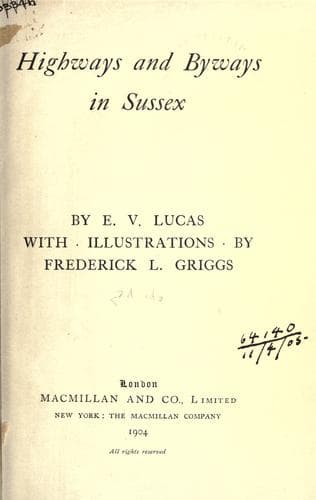
Highways and Byways in SussexLucas, E. V. (Edward Verrall)
History
Highways and Byways in Sussex
Lucas, E. V. (Edward Verrall)
Sussex (England) -- Description and travel
To persons who care little for new towns the value of Brighton lies in
its position as the key to good country. In a few minutes one can travel
by train to the Dyke, and leaving booths and swings behind, be free of
miles of turfed Down or cultivated Weald; in a few minutes one can reach
Hassocks, the station for Wolstonbury and Ditchling Beacon; in a few
minutes one can gain Falmer and plunge into Stanmer Park; or, travelling
to the next station, correct the effect of Brighton's hard brilliance
amid the soothing sleepinesses of Lewes; in a few minutes on the western
line one can be at Shoreham, amid ship-builders and sail-makers, or on
the ramparts of Bramber Castle, or among the distractions of Steyning
cattle market, with Chanctonbury Ring rising solemnly beyond. Brighton,
however, knows little of these homes of peace, for she looks only out to
sea or towards London.
[Sidenote: BRIGHTON'S STORIED PAST]
Brighton was, however, interesting a hundred years ago; when the
Pavilion was the favourite resort of the First Gentleman in Europe
(whose opulent charms, preserved in the permanency of mosaic, may be
seen in the Museum); when the Steyne was a centre of fashion and folly;
coaches dashed out of Castle Square every morning and into Castle Square
every evening; Munden and Mrs. Siddons were to be seen at one or other
of the theatres; Martha Gunn dipped ladies in the sea; Lord Frederick
Beauclerck played long innings on the Level; and Mr. Barrymore took a
pair of horses up Mrs. Fitzherbert's staircase and could not get them
down again without the assistance of a posse of blacksmiths.
Brighton was interesting then, reposing in the smiles of the Prince of
Wales and his friends. But it is interesting no more,--with the Pavilion
a show place, the Dome a concert hall, the Steyne an enclosure, Martha
Gunn in her grave, the Chain Pier a memory, Mrs. Fitzherbert's house the
headquarters of the Young Men's Christian Association, and the Brighton
road a racing track for cyclists, motor cars and walking stockbrokers.
Brighton is entertaining, salubrious, fashionable, what you will. Its
interest has gone.
The town's rise from Brighthelmstone (pronounced Brighton) a fishing
village, to Brighton, the marine resort of all that was most dashing in
English society, was brought about by a Lewes doctor in the days when
Lewes was to Brighton what Brighton now is to Lewes. This doctor was
Richard Russell, born in 1687, who, having published in 1750 a book on
the remedial effects of sea water, in 1754 removed to Brighton to be
able to attend to the many patients that were flocking thither. That
book was the beginning of Brighton's greatness. The seal was set upon it
in 1783, when the Prince of Wales, then a young man just one and twenty,
first visited the town.
[Sidenote: LE PRINCE S'AMUSE]
Public-domain text, read in full here on John Shaqi.
Reviews
Reviews
No reviews yet
Be the first to share your thoughts on this work.
Elsewhere in the archive
Join the Discussion
Join the discussion
Sign in to leave a comment or review.
Sign InorCreate an account