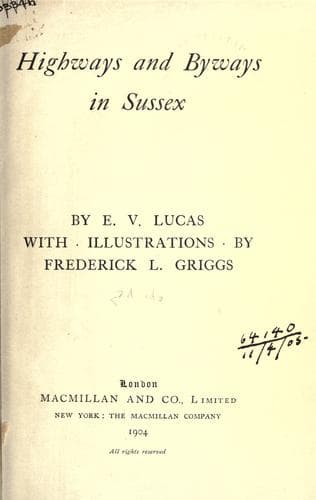
Highways and Byways in SussexLucas, E. V. (Edward Verrall)
History
Highways and Byways in Sussex
Lucas, E. V. (Edward Verrall)
Sussex (England) -- Description and travel
Beyond its connection with George IV. Brighton has played but a small
part in history, her only other monarch being Charles II., who merely
tarried in the town for awhile on his way to France, in 1651, as we have
seen. The King's Head, in West Street, claims to be the scene of the
merry monarch's bargain with Captain Nicholas Tattersall, who conveyed
him across the Channel; but there is good reason to believe that the inn
was the George in Middle Street, now demolished, but situated on the
site of No. 44. The epitaph on Tattersall in Brighton old parish church
contains the following lines:--
When Charles ye great was nothing but a breath
This valiant soul stept betweene him and death....
Which glorious act of his for church and state
Eight princes in one day did gratulate.
The episode of the captain's cautious bargaining with the King, of which
Colonel Gunter tells in the narrative from which I have quoted in an
earlier chapter, is carefully suppressed on the memorial tablet.
[Sidenote: PHEBE HESSEL]
Another famous Brighton character and friend of George IV. was Phebe
Hessel, who died at the age of 106, and whose tombstone may be seen in
the old churchyard. Phebe had a varied career, for having fallen in love
when only fifteen with Samuel Golding, a private in Kirk's Lambs, she
dressed herself as a man, enlisted in the 5th Regiment of Foot, and
followed him to the West Indies. She served there for five years, and
afterwards at Gibraltar, never disclosing her sex until her lover was
wounded and sent to Plymouth, when she told the General's wife, and was
allowed to follow and nurse him. On leaving hospital Golding married
her, and they lived, I hope happily, together for twenty years. When
Golding died Phebe married Hessel.
In her old age she became an important Brighton character, and
attracting the notice of the Prince was provided by him with a pension
of eighteen pounds a year, and the epithet "a jolly good fellow." It was
also the Prince's money which paid the stone cutter. When visited by a
curious student of human nature as she lay on her death-bed, Phebe
talked much of the past, he records, and seemed proud of having kept her
secret when in the army. "But I told it to the ground," she added; "I
dug a hole that would hold a gallon and whispered it there." Phebe kept
her faculties to the last, and to the last sold her apples to the
Quality by the sea, returned repartees with extraordinary verve and
contempt for false delicacy, and knew as much of the quality of Brighton
liquor as if she were a soldier in earnest.
Public-domain text, read in full here on John Shaqi.
Reviews
Reviews
No reviews yet
Be the first to share your thoughts on this work.
Elsewhere in the archive
Join the Discussion
Join the discussion
Sign in to leave a comment or review.
Sign InorCreate an account