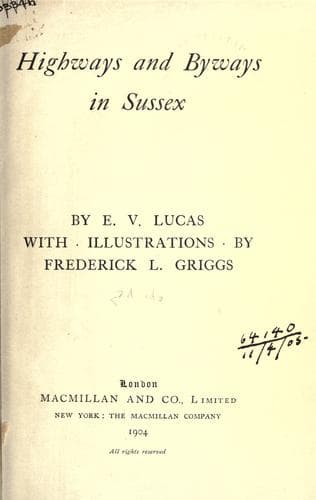
Highways and Byways in SussexLucas, E. V. (Edward Verrall)
History
Highways and Byways in Sussex
Lucas, E. V. (Edward Verrall)
Sussex (England) -- Description and travel
From Mrs. Pipchin's Paul Dombey passed to the forcing-house of Dr.
Blimber, Mrs. Blimber, Miss Blimber and Mr. Feeder, B.A., also at
Brighton, where he met Mr. Toots. "The Doctor's," says Dickens, "was a
mighty fine house, fronting the sea. Not a joyful style of house
within, but quite the contrary. Sad-coloured curtains, whose proportions
were spare and lean, hid themselves despondently behind the windows. The
tables and chairs were put away in rows, like figures in a sum; fires
were so rarely lighted in the rooms of ceremony, that they felt like
wells, and a visitor represented the bucket; the dining-room seemed the
last place in the world where any eating or drinking was likely to
occur; there was no sound through all the house but the ticking of a
great clock in the hall, which made itself audible in the very garrets;
and sometimes a dull cooing of young gentlemen at their lessons, like
the murmurings of an assemblage of melancholy pigeons."--Dr. Blimber's
must have been, I think, somewhere in the neighbourhood of the Bedford
Hotel.
[Sidenote: THACKERAY'S PRAISE]
Among other writers who have found Brighton good to work in I might name
the authors of _The Strange Adventures of a Phaeton_ and _A System of
Synthetic Philosophy_. Mr. William Black was for many years a familiar
figure on the Kemp Town parade, and Brighton plays a part in at least
two of his charming tales--_The Beautiful Wretch_, and an early and very
sprightly novel called _Kilmeny_. Brighton should be proud to think that
Mr. Herbert Spencer chose her as a retreat in which to come to his
conclusions; but I doubt if she is. Thackeray's affection is, however,
cherished by the town, his historic praise of "merry cheerful Dr.
Brighton" having a commercial value hardly to be over-estimated.
Brighton in return gave Thackeray Lord Steyne's immortal name and served
as a background for many of his scenes.
Although Brighton has still a fishing industry, the spectacle of its
fishermen refraining from work is not an uncommon one. It was once the
custom, I read, and perhaps still is, for these men, when casting their
nets for mackerel or herring, to stand with bare heads repeating in
unison these words: "There they goes then. God Almighty send us a
blessing it is to be hoped." As each barrel (which is attached to every
two nets out of the fleet, or 120 nets) was cast overboard they would
cry:--
Watch, barrel, watch! Mackerel for to catch,
White may they be, like a blossom on a tree.
God send thousands, one, two, and three,
Some by their heads, some by their tails,
God sends thousands, and never fails.
When the last net was overboard the master said, "Seas all!" and then
lowered the foremast and laid to the wind. If he were to say, "Last
net," he would expect never to see his nets again.
[Sidenote: BRIGHTON'S FAIR DAUGHTERS]
Public-domain text, read in full here on John Shaqi.
Reviews
Reviews
No reviews yet
Be the first to share your thoughts on this work.
Elsewhere in the archive
Join the Discussion
Join the discussion
Sign in to leave a comment or review.
Sign InorCreate an account