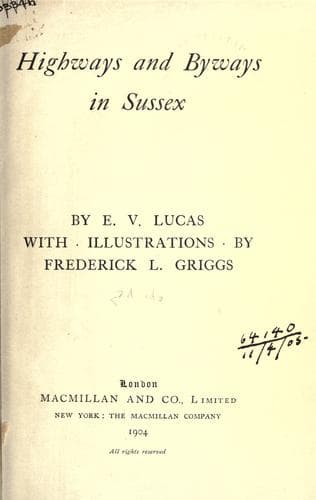
Highways and Byways in SussexLucas, E. V. (Edward Verrall)
History
Highways and Byways in Sussex
Lucas, E. V. (Edward Verrall)
Sussex (England) -- Description and travel
To its ordinary museum in the town Brighton has added the collection of
stuffed birds made by the late Mr. E. T. Booth, which he housed in a
long gallery in the road that leads to the Dyke. Mr. Booth, when he shot
a bird in its native haunts, carried away some of its surroundings in
order that the taxidermist might reproduce as far as possible its
natural environment. Hence every case has a value that is missing when
one sees merely the isolated stuffed bird. In one instance realism has
dictated the addition of a clutch of pipit's eggs found on the Bass
Rock, in a nest invisible to the spectator. The collection in the
Natural History Museum at South Kensington is of course more
considerable, and finer, but some of Mr. Booth's cases are certainly
superior, and his collection has the special interest of having been
made by one man.
[Sidenote: CRITICISM BY JUG]
Brighton has another very interesting possession in the collection of
old domestic pottery in the museum: an assemblage (the most entertaining
and varied that I know) of jugs and mugs, plates and ornaments, all
English, all quaint and characteristic too, and mostly inscribed with
mottoes or decorated with designs in celebration of such events as the
battle of Waterloo, or the discomfiture of Mr. Pitt, or a victory of Tom
Cribb. Others are ceramic satires on the drunkard's folly or the
inconstancy of women. Why are the potters of our own day so dull?
History is still being made, human nature is not less frail; but I see
no genial commentary on jug or dish. Is it the march of Taste?
CHAPTER XVIII
ROTTINGDEAN AND WHEATEARS
Ovingdean--Charles II.--The introduction of Mangel
Wurzel--Rottingdean as a shrine--Mr. Kipling's Sussex poem--Thomas
Fuller on the Wheatear--Mr. Hudson's description of the traps--The
old prosperous days for shepherds--Luring larks--A fight on the
beach--The town that failed.
Beyond Kemp Town's serene and silent line of massive houses is the new
road that leads to Rottingdean. The old road fell into the sea some few
years ago--the fourth or fifth to share that fate. But the pleasantest
way thither is on foot over the turf that tops the white cliffs.
By diverging inland between Brighton and Rottingdean, just beyond the
most imposing girls' school in the kingdom, Ovingdean is reached, one of
the nestling homesteads of the Downs. It is chiefly known as providing
Harrison Ainsworth with the very pretty title of one of his stories,
_Ovingdean Grange_. The gallant novelist, however, was a poor historian
in this book, for Charles the Second, as we have seen, never set foot
east of Brighton on the occasion of his journey of escape over the
Sussex Downs. The legend that lodges him at Ovingdean, although one can
understand how Ovingdean must cherish it, cannot stand. (Mock Beggars'
Hall, in the same romance, is Southover Grange at Lewes.)
Public-domain text, read in full here on John Shaqi.
Reviews
Reviews
No reviews yet
Be the first to share your thoughts on this work.
Elsewhere in the archive
Join the Discussion
Join the discussion
Sign in to leave a comment or review.
Sign InorCreate an account