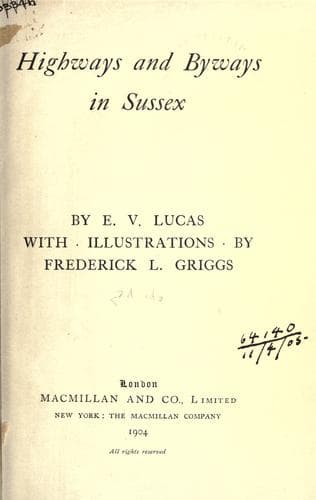
Highways and Byways in SussexLucas, E. V. (Edward Verrall)
History
Highways and Byways in Sussex
Lucas, E. V. (Edward Verrall)
Sussex (England) -- Description and travel
Here leaps ashore the full Sou'west
All heavy-winged with brine,
Here lies above the folded crest
The Channel's leaden line;
And here the sea-fogs lap and cling,
And here, each warning each,
The sheep-bells and the ship-bells ring
Along the hidden beach.
We have no waters to delight
Our broad and brookless vales--
Only the dewpond on the height
Unfed, that never fails,
Whereby no tattered herbage tells
Which way the season flies--
Only our close-bit thyme that smells
Like dawn in Paradise.
Here through the strong and salty days
The unshaded silence thrills;
Or little, lost, Down churches praise
The Lord who made the Hills:
But here the Old Gods guard their round,
And, in her secret heart,
The heathen kingdom Wilfrid found
Dreams, as she dwells, apart.
[Sidenote: WHEATEARS]
Of old the best wheatear country was above Rottingdean; but the South
Down shepherds no longer have the wheatear money that used to add so
appreciably to their wages in the summer months. A combination of
circumstances has brought about this loss. One is the decrease in
wheatears, another the protection of the bird by law, and a third the
refusal of the farmers to allow their men any longer to neglect the
flocks by setting and tending snares. But in the seventeenth, eighteenth
and early part of the nineteenth centuries, wheatears were taken on the
Downs in enormous quantities and formed a part of every south county
banquet in their season. People visited Brighton solely to eat them, as
they now go to Greenwich for whitebait and to Colchester for oysters.
This is how Fuller describes the little creature in the
_Worthies_--"_Wheatears_ is a bird peculiar to this County, hardly found
out of it. It is so called, because fattest when Wheat is ripe, whereon
it feeds; being no bigger than a Lark, which it equalleth in _fineness_
of the flesh, far exceedeth in the _fatness_ thereof. The worst is, that
being onely seasonable in the heat of summer, and naturally larded with
lumps of fat, it is soon subject to corrupt, so that (though abounding
within _fourty_ miles) _London Poulterers_ have no mind to meddle with
them, which no care in carriage can keep from Putrefaction. That
_Palate-man_ shall pass in silence, who, being seriously demanded his
judgment concerning the abilities of a great _Lord_, concluded him a man
of very weak parts, '_because once he saw him, at a_ great Feast, _feed
on_ CHICKENS _when there were_ WHEATEARS _on the Table_.' I will adde no
more in praise of this _Bird_, for fear some _female Reader_ may fall in
_longing_ for it, and unhappily be disappointed of her desire." A
contemporary of Fuller, John Taylor, from whom I have already quoted,
and shall quote again, thus unscientifically dismisses the wheatear in
one of his doggerel narratives:--
Public-domain text, read in full here on John Shaqi.
Reviews
Reviews
No reviews yet
Be the first to share your thoughts on this work.
Elsewhere in the archive
Join the Discussion
Join the discussion
Sign in to leave a comment or review.
Sign InorCreate an account