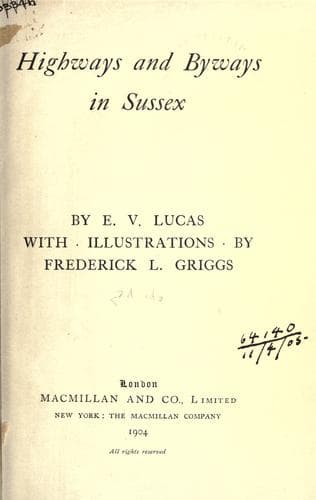
Highways and Byways in SussexLucas, E. V. (Edward Verrall)
History
Highways and Byways in Sussex
Lucas, E. V. (Edward Verrall)
Sussex (England) -- Description and travel
An old shepherd, who had been for years on Westside Farm near Brighton,
spoke thus, in 1882, as Mr. Borrer relates in his _Birds of
Sussex_:--"The most I ever caught in one day was thirteen dozen, but we
thought it a good day if we caught three or four dozen. We sold them to
a poulterer at Brighton, who took all we could catch in a season at
18_d._ a dozen. From what I have heard from old shepherds, it cannot be
doubted that they were caught in much greater numbers a century ago than
of late. I have heard them speak of an immense number being taken in one
day by a shepherd at East Dean, near Beachy Head. I think they said he
took nearly a hundred dozen, so many that they could not thread them on
crow-quills in the usual manner, but he took off his round frock and
made a sack of it to put them into, and his wife did the same with her
petticoat. This must have happened when there was a great flight. Their
numbers now are so decreased that some shepherds do not set up any
coops, as it does not pay for the trouble."
[Sidenote: THE LARK-GLASS]
Although wheatears are no longer caught, the Brighton bird-catcher is a
very busy man. Goldfinches fall in extraordinary plenty to his nets. A
bird-catcher told Mr. Borrer that he once caught eleven dozen of them at
one haul, and in 1860 the annual take at Worthing was 1,154 dozen. Larks
are also caught in great numbers, also with nets, the old system still
practised in France, of luring them with glasses, having become
obsolete. Knox has an interesting description of the lark-glass and its
uses:--"A piece of wood about a foot and a half long, four inches deep,
and three inches wide, is planed off on two sides so as to resemble the
roof of a well-known toy, yclept a Noah's ark, but, more than twice as
long. In the sloping sides are set several bits of looking-glass. A long
iron spindle, the lower end of which is sharp and fixed in the ground,
passes freely through the centre; on this the instrument turns, and even
spins rapidly when a string has been attached and is pulled by the
performer, who generally stands at a distance of fifteen or twenty yards
from the decoy. The reflection of the sun's rays from these little
revolving mirrors seems to possess a mysterious attraction for the
larks, for they descend in great numbers from a considerable height in
the air, hover over the spot, and suffer themselves to be shot at
repeatedly without attempting to leave the field or to continue their
course."
Public-domain text, read in full here on John Shaqi.
Reviews
Reviews
No reviews yet
Be the first to share your thoughts on this work.
Elsewhere in the archive
Join the Discussion
Join the discussion
Sign in to leave a comment or review.
Sign InorCreate an account