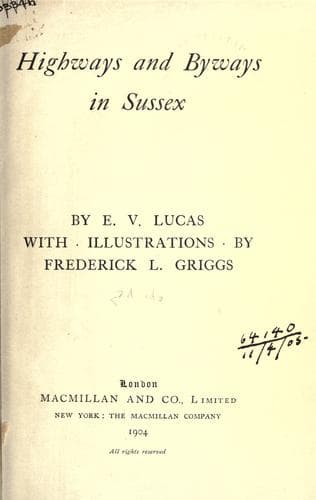
Highways and Byways in SussexLucas, E. V. (Edward Verrall)
History
Highways and Byways in Sussex
Lucas, E. V. (Edward Verrall)
Sussex (England) -- Description and travel
West of Hove, and between that town and Portslade-by-Sea, is Aldrington.
Aldrington is now new houses and brickfields. Thirty years ago it was
naught. But five hundred years ago it was the principal township in
these parts, and Brighthelmstone a mere insignificant cluster of hovels.
Centuries earlier it was more important still, for, according to some
authorities, it was the Portus Adurni of the Romans. The river Adur,
which now enters the sea between Shoreham and Southwick, once flowed
along the line of the present canal and the Wish Pond, and so out into
the sea. I have seen it stated that the mouth of the river was even more
easterly still--somewhere opposite the Norfolk Hotel at Brighton; but
this may be fanciful and can now hardly be proven. The suggestion,
however, adds interest to a walk on the otherwise unromantic Brunswick
Lawns. In those days the Roman ships, entering the river here, would
sail up as far as Bramber. Between the river and the sea were then some
two miles--possibly more--of flat meadow land, on which Aldrington was
largely built. Over the ruins of that Aldrington the Channel now washes.
[Sidenote: THE LIFE OF A HARBOUR]
Beyond Aldrington is Portslade, with a pretty inland village on the
hill; beyond Portslade is Southwick, notable for its green; and beyond
Southwick is Shoreham. Southwick and Shoreham both have that interest
which can never be wanting to the seaport that has seen better days. The
life of a harbour, whatever its state of decay, is eternally absorbing;
and in Shoreham harbour one gets such life at its laziest. The smell of
tar; the sound of hammers; the laughter and whistling of the loafers;
the continuous changing of the tide; the opening of the lock gates; the
departure of the tug; its triumphant return, leading in custody a
timber-laden barque from the Baltic, a little self-conscious and
ashamed, as if caught red-handed in iniquity by this fussy little
officer; the independent sailing of a grimy steamer bound for Sunderland
and more coal; the elaborate wharfing of the barque:--all these things
on a hot still day can exercise an hypnotic influence more real and
strange than the open sea. The romance and mystery of the sea may indeed
be more intimately near one on a harbour wharf than on the deck of a
liner in mid-ocean.
Shoreham has its place in history. Thence as we have seen, sailed
Charles II. in Captain Tattersall's _Enterprise_. Four hundred and
fifty years earlier King John landed here with his army, when he came to
succeed to the English throne. In the reign of Edward III. Shoreham
supplied twenty-six ships to the Navy: but in the fifteenth century the
sea began an encroachment on the bar which disclassed the harbour. It is
now unimportant, most of the trade having passed to Newhaven; but in its
days of prosperity great cargoes of corn and wine were landed here from
the Continent.
Public-domain text, read in full here on John Shaqi.
Reviews
Reviews
No reviews yet
Be the first to share your thoughts on this work.
Elsewhere in the archive
Join the Discussion
Join the discussion
Sign in to leave a comment or review.
Sign InorCreate an account