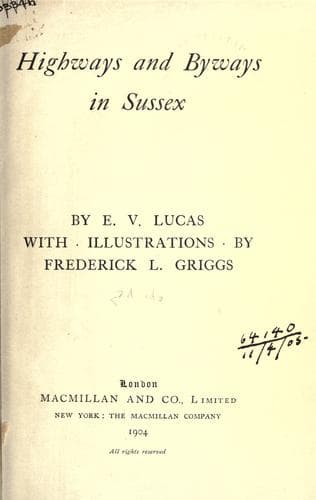
Highways and Byways in SussexLucas, E. V. (Edward Verrall)
History
Highways and Byways in Sussex
Lucas, E. V. (Edward Verrall)
Sussex (England) -- Description and travel
Among other men of note who have lived in Lewes or have had association
with it, was John Evelyn the diarist, who had some of his education at
Southover grammar school: Mark Antony Lower, the Sussex antiquary, to
whom all writers on the county are indebted; the Rev. T. W. Horsfield,
the historian of Sussex, without whose work we should also often be in
difficulties; and the Rev. Gideon Mantell, the Sussex geologist, whose
collection of Sussex fossils is preserved in the British Museum.
In St. Ann's church on the hill lie the bones of a remarkable man who
died at Lewes (in the tenth climacteric) in 1613--no less a person than
Thomas Twyne, M.D. In addition to the principles of physic he
"comprehended earthquakes" and wrote a book about them. He also wrote a
survey of the world. I quote Horsfield's translation of the florid Latin
inscription to his memory: "Hippocrates saw Twyne lifeless and his bones
slightly covered with earth. Some of his sacred dust (says he) will be
of use to me in removing diseases; for the dead, when converted into
medicine, will expel human maladies, and ashes prevail against ashes.
Now the physician is absent, disease extends itself on every side, and
exults its enemy is no more. Alas! here lies our preserver Twyne; the
flower and ornament of his age. Sussex deprived of her physician,
languished, and is ready to sink along with him. Believe me, no future
age will produce so good a physician and so renowned a man as this has.
He died at Lewes in 1613, on the 1st of August, in the tenth
climacteric, (viz. 70)."
[Sidenote: DR. JOHNSON AT LEWES]
Dr. Johnson was once in Lewes, on a day's visit to the Shelleys, at the
house which bears their name at the south end of the town. One of the
little girls becoming rather a nuisance with her questions, the Doctor
lifted her into a cherry tree and walked off. At dinner, some time
later, the child was missed, and a search party was about to set out
when the Doctor exclaimed, "Oh, I left her in a tree!" For many years
the tree was known as "Dr. Johnson's cherry tree."
[Illustration: _St. Ann's Church, Southover._]
[Sidenote: THE FIFTH]
Lewes is ordinarily still and leisurely, with no bustle in her steep
streets save on market days: an abode of rest and unhastening feet. But
on one night of the year she lays aside her grey mantle and her quiet
tones and emerges a Bacchante robed in flame. Lewes on the 5th of
November is an incredible sight; probably no other town in the United
Kingdom offers such a contrast to its ordinary life. I have never heard
that Lewes is notably Protestant on other days in the year, that any
intolerance is meted out to Roman Catholics on November 4th or November
6th; but on November 5th she appears to believe that the honour of the
reformed church is wholly in her hands, and that unless her voice is
heard declaiming against the tyrannies and treacheries of Rome all the
spiritual labours of the eighth Henry will have been in vain.
Public-domain text, read in full here on John Shaqi.
Reviews
Reviews
No reviews yet
Be the first to share your thoughts on this work.
Elsewhere in the archive
Join the Discussion
Join the discussion
Sign in to leave a comment or review.
Sign InorCreate an account