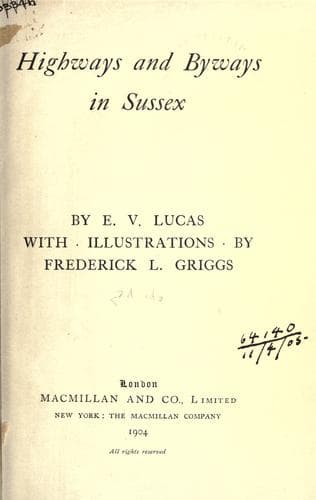
Highways and Byways in SussexLucas, E. V. (Edward Verrall)
History
Highways and Byways in Sussex
Lucas, E. V. (Edward Verrall)
Sussex (England) -- Description and travel
The first village out of Lewes on the Newhaven road is Kingston (one of
three Sussex villages of this name), on the side of the hill, once the
property of Sir Philip Sidney. Next is Iford, with straw blowing free
and cows in its meadows; next Rodmell, whence Whiteway Bottom and Breaky
Bottom lead to the highlands above: next Southease, where the only
bridge over the Ouse between Lewes and Newhaven is to be crossed: a
little village famous for a round church tower, of which Sussex knows
but three, one other at St. Michael's, Lewes, and one at Piddinghoe, the
next village.
[Sidenote: SOUTHEASE THIRST]
The Southease rustics were once of independent mind, as may be gathered
from the following extract from the "Manorial Customs of
Southease-with-Heighton, near Lewes," in 1623: "Every reaper must have
allowed him, at the cost of the lord or his farmer, one drinkinge in the
morninge of bread and cheese, and a dinner at noone consistinge of
rostmeate and other good victualls, meete for men and women in harvest
time; and two drinkinges in the afternoone, one in the middest of their
afternoone's work and the other at the ende of their day's work, and
drinke alwayes duringe their work as neede shall require."
[Sidenote: PIDD'NHOO]
Telscombe, the capital of these lonely Downs and as good an objective as
the walker who sets out from Brighton, Rottingdean, or Lewes to climb
hills can ask, is a charming little shy hamlet which nothing can harm,
snugly reposing in its combe, above Piddinghoe. Piddinghoe (pronounced
Pidd'nhoo) is a compact village at the foot of the hill; but it has
suffered in picturesqueness and character by its proximity to the
commercial enterprise of Newhaven. Hussey, in his _Notes on the Churches
of ... Sussex_, suggests that a field north of the village was once the
site of a considerable Roman villa. A local sarcasm credits Piddinghoe
people with the habit of shoeing their magpies.
[Illustration: _Piddinghoe._]
The Downs when we saw them first, between Midhurst and Chichester,
formed an inland chain parallel with the shore: here, and eastward as
far as Beachy Head, where they suddenly cease, their southern slopes are
washed by the Channel. This companionship of the sea lends them an
additional wildness: sea mists now and then envelop them in a cloud; sea
birds rise and fall above their cliffs; the roar or sigh of the waves
mingles with the cries of sheep; the salt savour of the sea is borne on
the wind over the crisp turf. It was, I fancy, among the Downs in this
part of Sussex that Mrs. Marriott-Watson wrote the intimately
understanding lines which I take the liberty of quoting:
[Sidenote: A HILL POEM]
ON THE DOWNS.
Broad and bare to the skies
The great Down-country lies,
Green in the glance of the sun,
Fresh with the clean salt air;
Screaming the gulls rise from the fresh-turned mould,
Where the round bosom of the wind-swept wold
Slopes to the valley fair.
Public-domain text, read in full here on John Shaqi.
Reviews
Reviews
No reviews yet
Be the first to share your thoughts on this work.
Elsewhere in the archive
Join the Discussion
Join the discussion
Sign in to leave a comment or review.
Sign InorCreate an account