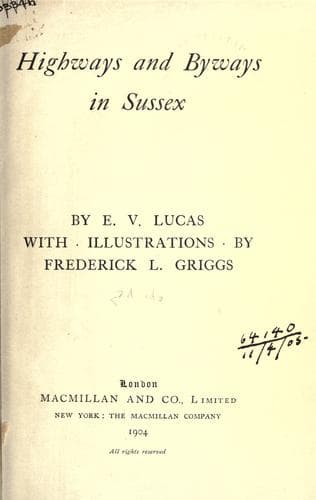
Highways and Byways in SussexLucas, E. V. (Edward Verrall)
History
Highways and Byways in Sussex
Lucas, E. V. (Edward Verrall)
Sussex (England) -- Description and travel
In 1767 the landlord was, according to a private letter, "as great a
curiosity as the house." I wish we had some information about him, for
the house is quaint and curious indeed, with its red lion sentinel at
the side (figure-head from a Dutch wreck in Cuckmere Haven), and its
carvings inside and out. The old and the new mingled very oddly when I
was lately at Alfriston. Hearing a familiar sound, as of a battledore
and a ball, in one of the rooms, I opened the door and discovered the
landlord and a groom from the racing stables near by in the throes of
the most modern of games, amid surroundings absolutely mediæval.
[Sidenote: THE CATHEDRAL OF THE DOWNS]
The size of the grave and commanding church, which has been called the
cathedral of the South Downs, alone proves that Alfriston was once a
vastly more important place than it now is. Legend says that the
foundations were first cut in the meadow known as Savyne Croft. There
day after day the builders laid their stones, arriving each morning to
find them removed to the Tye, the field where the church now stands. At
last the meaning of the miracle entered their heads, and the church was
erected on the new site. Its shape was determined by the slumbers of
four oxen, who were observed by the architect to be sleeping in the form
of a cross. Poynings church, under the Dyke Hill, near Brighton, was
built, it has been conjectured, by the same architect. Within the
cathedral of the South Downs, which is a fourteenth century building, is
a superb east window, but it has no coloured glass. The register,
beginning with 1504, is perhaps the oldest in England. Hard by the
church is the simple little clergy house--unique in England, I
believe--dating from pre-Reformation times. It has lately been very
carefully restored.
Alfriston once had a scholar in the person of Thomas Chowne, of Frog
Firle, the old house on the road to Seaford, about a mile beyond the
village. Chowne, who died in 1639, and was buried at Alfriston, is thus
touched off by Fuller:--"Thomas Chune, Esquire, living at Alfriston in
this County, set forth a small Manuall, intituled _Collectiones
Theologicarum Conclusionum_. Indeed, many have much opposed it (as what
book meeteth not with opposition?); though such as dislike must commend
the brevity and clearness of his Positions. For mine own part, I am glad
to see a Lay-Gentleman so able and industrious." Chowne's great great
grandson, an antiquary, one night left some books too near his library
fire; they ignited, and Frog Firle Place was in large part destroyed. It
is now only a fragment of what it was, and is known as Burnt House.
[Sidenote: AN ALFRISTON DOCTOR]
Public-domain text, read in full here on John Shaqi.
Reviews
Reviews
No reviews yet
Be the first to share your thoughts on this work.
Elsewhere in the archive
Join the Discussion
Join the discussion
Sign in to leave a comment or review.
Sign InorCreate an account