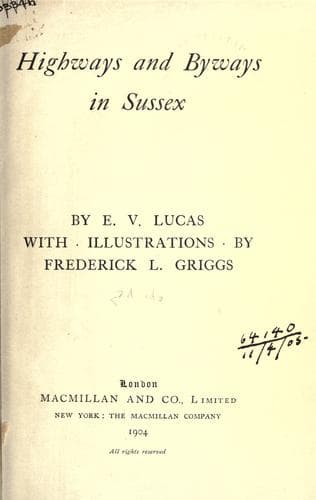
Highways and Byways in SussexLucas, E. V. (Edward Verrall)
History
Highways and Byways in Sussex
Lucas, E. V. (Edward Verrall)
Sussex (England) -- Description and travel
Not that the sea smuggler ran no risks. On the contrary, he was
continually in danger from revenue cutters and the coastguards' boats.
Bloody fights in the Channel were by no means rare. He was also often in
peril from the elements; his endurance was superb; he had to be a sailor
of genius, ready for every kind of emergency. But the land smuggler was
more vulnerable than the sea smuggler, his rewards were smaller, and his
operations were less simple. There is a vast difference between a dark
night at sea and a dark night on land. Once the night fell the sea was
the smuggler's own: he was invisible, inaudible. But the land was not
less the revenue officer's: the land smuggler had to show his signal
light, he had to roll casks over the beach, he had to carry them into
security. His horse's hoofs could not be stilled as oars are muffled,
his wheels bit noisily into the road, he was liable to be stopped at any
turn. And he ran these risks from the coast right into London. I doubt
if the land smuggler has had his due of praise. Sometimes the land
smuggler had to be land smuggler and sea smuggler too, for many of the
ships never troubled to make a landing at all. They sailed as near the
shore as might be and then sank the tubs, which were always lashed
together and kept on deck in readiness to be thrown overboard in case of
the approach of a cutter. The position of the mooring having been
conveyed to the confederates on shore, the vessel was at liberty to
return to France for another cargo, leaving the responsibility of
fishing up the tubs, and getting them to shore and away, wholly with the
land smuggler.
An old pamphlet, entitled, _The Trials of the Smugglers ... at the
Assizes held at East Grinstead, March 13, 14, 15, and 16, 1748-9_, gives
the following information about the duties and pay of the land smugglers
at that day:--"Each Man is allowed Half a Guinea a Time, and his
Expenses for Eating and Drinking, a Horse found him, and the Profits of
a Dollop of Tea, which is about 13 Pounds Weight, being the Half of a
Bag; which Profit, even from the most ordinary of their Teas, comes to
24 or 25 Shillings; and they always make one Journey, sometimes two, in
a Week." But these men would be underlings. There were, I take it, land
smugglers in control of the operations who shared on a more lordly scale
with their brethren in the boat.
[Sidenote: HALF-WAY HOUSES]
Public-domain text, read in full here on John Shaqi.
Reviews
Reviews
No reviews yet
Be the first to share your thoughts on this work.
Elsewhere in the archive
Join the Discussion
Join the discussion
Sign in to leave a comment or review.
Sign InorCreate an account