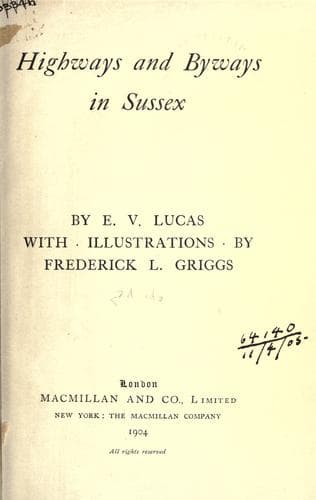
Highways and Byways in SussexLucas, E. V. (Edward Verrall)
History
Highways and Byways in Sussex
Lucas, E. V. (Edward Verrall)
Sussex (England) -- Description and travel
John Ellman by no means satisfied all his fellow breeders that he was
right. His neighbour at Glynde, Mr. Morris, differed from him in the
matter of crossing, and his cousin Thomas had other views on many points
touching the flock. In the following passage Arthur Young expresses the
extent to which individuality in sheep breeding may run:--"The South
Down farmers breed their sheep with faces and legs of a colour, just as
suits their fancy. One likes black, another sandy, a third speckled, and
one and all exclaim against white. This man concludes that legs and
faces with an inclination to white are infallible signs of tenderness,
and do not stand against the severity of the weather with the same
hardiness as the darker breed; and they allege that these sorts will
fall off in their flesh. A second will set the first right, and
pronounce that, in a lot of wethers, those that are soonest and most
fat, are white-faced; that they prove remarkable good milkers; but that
white is an indication of a tender breed. Another is of opinion that, by
breeding the lambs too black, the wool is injured, and likewise apt to
be tainted with black, and spotted, especially about the neck, and not
saleable. A fourth breeds with legs and faces as black as it is
possible; and he too is convinced that the healthiness is in proportion
to blackness; whilst another says, that if the South Down sheep were
suffered to run in a wild state, they would in a very few years become
absolutely black. All these are the opinions of eminent breeders: in
order to reconcile them, others breed for speckled faces; and it is the
prevailing colour."
It is told that when the Duke of Newcastle used to pass through Glynde,
on his way from Halland House, near East Hoathly, to Bishopstone, the
peal of welcome was rung on ploughshares, since there was but one bell.
Ringmer, which lies about two miles north of Glynde, is not in itself a
village of much beauty. Its distinction is to have provided William Penn
with a wife--Gulielma Springett, daughter of Sir William Springett, a
Puritan, whose bust is in the church and who died at the siege of
Arundel Castle. The great Quaker thus took to wife the daughter of a
soldier. When Gulielma Penn died, at the age of fifty, her husband wrote
of her: "She was a Publick, as well as Private Loss; for she was not
only an excellent Wife and Mother, but an Entire and Constant Friend, of
a more than common Capacity, and greater Modesty and Humility; yet most
equal and undaunted in Danger. Religious as well as Ingenuous, without
Affectation. An easie Mistress, and Good Neighbour, especially to the
Poor. Neither lavish nor penurious, but an Example of Industry as well
as of other Vertues: Therefore our great Loss tho' her own Eternal
Gain."
[Sidenote: GODLY WIVES]
In Ringmer Church, I might add, is a monument to Mrs. Jeffray (_née_
Mayney), wife of Francis Jeffray of South Malling, with another
beautiful testimony to the character of a good wife:--
Public-domain text, read in full here on John Shaqi.
Reviews
Reviews
No reviews yet
Be the first to share your thoughts on this work.
Elsewhere in the archive
Join the Discussion
Join the discussion
Sign in to leave a comment or review.
Sign InorCreate an account