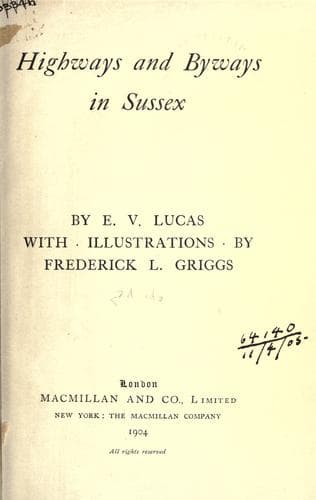
Highways and Byways in SussexLucas, E. V. (Edward Verrall)
History
Highways and Byways in Sussex
Lucas, E. V. (Edward Verrall)
Sussex (England) -- Description and travel
When, in 1703, the King of Spain visited the Duke of Somerset at
Petworth he had the greatest difficulty in getting here. One of his
attendants has put on record the perils of the journey:--"We set out at
six o'clock in the morning (at Portsmouth) to go to Petworth, and did
not get out of the coaches, save only when we were overturned or stuck
fast in the mire, till we arrived at our journey's end. 'Twas hard
service for the prince to sit fourteen hours in the coach that day,
without eating anything, and passing through the worst ways that I ever
saw in my life: we were thrown but once indeed in going, but both our
coach which was leading, and his highness's body coach, would have
suffered very often, if the nimble boors of Sussex had not frequently
poised it, or supported it with their shoulders, from Godalming almost
to Petworth; and the nearer we approached the duke's, the more
inaccessible it seemed to be. The last nine miles of the way cost six
hours time to conquer."
To return to Ringmer, it was there that Gilbert White studied the
tortoise (see Letter xiii of _The Natural History of Selborne_). The
house where he stayed still stands, and the rookery still exists. "These
rooks," wrote the naturalist, "retire every morning all the winter from
this rookery, where they only call by the way, as they are going to
roost in deep woods; at the dawn of day they always revisit their
nest-trees, and are preceded a few minutes by a flight of daws, that
act, as it were, as their harbingers." An intermediate owner of the
house where Gilbert White resided, which then belonged to his aunt
Rebecca Snooke, ordered all nightingales to be shot, on the ground that
they kept him awake.
[Sidenote: PLASHETTS]
While at Ringmer, if a glimpse of very rich park land is needed, it
would be worth while to walk three miles north to Plashetts, which
combines a vast tract of wood with a small park notable at once for its
trees, its brake fern, its lakes, and its water fowl. But if one would
gain it by rail, Isfield is the station.
CHAPTER XXXI
UCKFIELD AND BUXTED
The Crowborough district--Isfield--Another model
wife--Framfield--The poet Realf--Uckfield--The Maresfield
rocks--Puritan names in Sussex--Buxted park--Heron's Ghyll--A
perfect church.
Public-domain text, read in full here on John Shaqi.
Reviews
Reviews
No reviews yet
Be the first to share your thoughts on this work.
Elsewhere in the archive
Join the Discussion
Join the discussion
Sign in to leave a comment or review.
Sign InorCreate an account