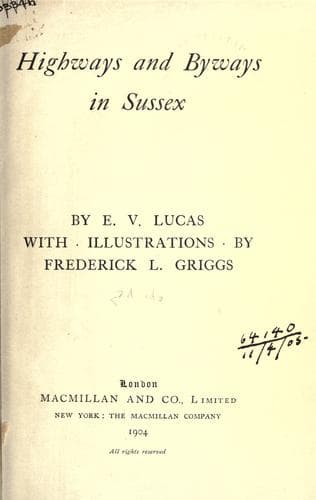
Highways and Byways in SussexLucas, E. V. (Edward Verrall)
History
Highways and Byways in Sussex
Lucas, E. V. (Edward Verrall)
Sussex (England) -- Description and travel
In the spring of this year (1903) the walls and fences of Crowborough
were covered with the placards of a firm of estate agents describing the
neighbourhood (in the manner of the great George Robins) as "Scotland in
Sussex." The simile may be true of the Ashdown Forest side of the Beacon
(although involving an unnecessary confusion of terms), but "Hampstead
in Sussex" would be a more accurate description of Crowborough proper.
Never was a fine remote hill so be-villa'd. The east slope is all
scaffold-poles and heaps of bricks, new churches and chapels are
sprouting, and the many hoardings announce that Follies, Pierrots, or
conjurors are continually imminent. Crowborough itself has shops that
would not disgrace Croydon, and a hotel where a Lord Mayor might feel at
home. Houses in their own grounds are commoner than cottages, and near
the summit the pegs of surveyors and the name-boards of avenues yet to
be built testify to the charms which our Saxon Caledonia has already
exerted.
But to say this is not to say all. Crowborough may be populous and
over-built; but it is still a glorious eminence, the healthiest and most
bracing inland village in the county, and the key to its best moorland
country. Since Crowborough's normal visitor either plays golf or is
contented with a very modest radius, the more adventurous walker may
quickly be in the solitudes.
In the little stone house below the forge Richard Jefferies lived for
some months at the end of his life.
[Sidenote: ROTHERFIELD]
Crowborough is crowned by a red hotel which can never pass into the
landscape; Rotherfield, its companion hill on the east, on the other
side of the Jarvis Brook valley, is surmounted by a beautiful church
with a tall shingled spire, that must have belonged to the scene from
the first. This spire darts up from the edge of the forest ridge like a
Pharos for the Weald of Kent. The church was dedicated to St. Denis of
Paris by a Saxon chieftain who was cured of his ills by a pilgrimage to
the Saint's monastery. That was in 792. In the present church, which
retains the dedication, is an ancient mural painting representing the
martyrdom of St. Lawrence. There is also a Burne-Jones window.
Were it not for Rotherfield both Sussex and Kent would lack some of
their waterways, for the Rother and the Ouse rise here, and also the
Medway. A local saying credits the women of Rotherfield with two ribs
more than the men, to account for their superior height.
Under a hedge half-way between Rotherfield and Jarvis Brook grow the
largest cowslips in Sussex, as large as cowslips may be without changing
their sex. But this is all cowslip country--from the field of Rother to
the field of Uck. And it is the land of the purple orchis too, the
finest blooms of which are to be found on the road between Rotherfield
and Mayfield; but you must scale a fence to get them, because (like all
the best wild flowers) they belong to the railway.
Public-domain text, read in full here on John Shaqi.
Reviews
Reviews
No reviews yet
Be the first to share your thoughts on this work.
Elsewhere in the archive
Join the Discussion
Join the discussion
Sign in to leave a comment or review.
Sign InorCreate an account