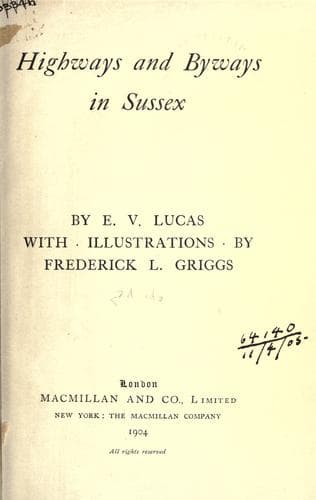
Highways and Byways in SussexLucas, E. V. (Edward Verrall)
History
Highways and Byways in Sussex
Lucas, E. V. (Edward Verrall)
Sussex (England) -- Description and travel
The remains of Mayfield Palace, the old abode of the Archbishops of
Canterbury, join the church. After it had passed into the hands of the
crown--for Cranmer made a bargain with the King by which Mayfield was
exchanged for other property--Sir Thomas Gresham lived here, and Queen
Elizabeth has dined under its roof. The Palace is to be seen only
occasionally, for it is now a convent, Mayfield being another of the
county's many Roman Catholic outposts. In the great dining-room are the
tongs which St. Dunstan used.
The church, dedicated to Mayfield's heroic saint, has one of the broader
shingled spires of Sussex, as distinguished from the slender spires of
which Rotherfield is a good example. Standing high, it may be seen from
long distances. The tower is the original Early English structure. Four
more of the old Sussex iron tomb slabs may be seen at Mayfield. In the
churchyard, says Mr. Lower, was once an inscription with this
uncomplimentary first line:--
O reader, if that thou canst read,
It continued:--
Look down upon this stone;
Death is the man, do you what you can,
That never spareth none!
In Mayfield's street even the new houses have caught comeliness from
their venerable neighbours. It undulates from gable to gable, and has
two good inns. The old timbered house in the middle of the east side is
that to which Richard Jefferies refers without enthusiasm in the passage
which I quote in a later chapter from his essay on Buckhurst Park. In
Louis Jennings' _Field Paths and Green Lanes_ the house comes in for
eulogy.
Vicar of Mayfield in 1361 and following years was John Wickliffe, who
has too often been confused with his great contemporary and namesake,
the reformer. And the village claims as a son Thomas May (1595-1650),
playwright, translator of Lucan's "Pharsalia," secretary to Parliament
and friend of Ben Jonson.
In the Sussex Archæological Collections is printed the journal of Walter
Gale, schoolmaster at Mayfield in the latter half of the eighteenth
century, from which a few extracts may be given:
"1750. I found the greatest part of the school in a flow, by reason of
the snow and rain coming through the leads. The following extempore
verse I set for a copy:--
Abandon every evil thought
For they to judgment will be brought.
In passing the Star I met with Mr. Eastwood; we went in and spent 2_d._
apiece.
[Sidenote: PRESAGES OF DEATH]
Public-domain text, read in full here on John Shaqi.
Reviews
Reviews
No reviews yet
Be the first to share your thoughts on this work.
Elsewhere in the archive
Join the Discussion
Join the discussion
Sign in to leave a comment or review.
Sign InorCreate an account