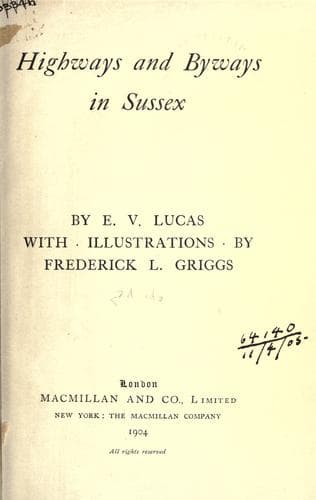
Highways and Byways in SussexLucas, E. V. (Edward Verrall)
History
Highways and Byways in Sussex
Lucas, E. V. (Edward Verrall)
Sussex (England) -- Description and travel
There are two Heathfields: the old village, with its pleasant Sussex
church and ancient cottages close to the park gates; and the new brick
and slate town that has gathered round the station and the natural
gas-works. The park lies between the two, remarkable among Sussex parks
for the variety of its trees and the unusual proportion of them. The
spacious lawns which are characteristic of the parks in the south, here,
on Heathfield's sandy undulations, give place to heather, fern and
trees. I never remember to have seen a richer contrast of greens than in
early spring, looking west from the house, between the masses of dark
evergreens that had borne the rigours of the winter and the young leaves
just breaking through. Heathfield's park is, I think, the loveliest in
Sussex, lying as it does on a southern slope, with its opulence of
foliage, its many rushing burns (the source of the Cuckmere), its hidden
ravines and deep silent tarns, and its wonderful view of the Downs and
the sea. The park once belonged to the Dacres of Hurstmonceaux, whom we
are about to meet. Traces of the original house, dating probably from
Henry VII.'s reign, are still to be seen in the basement. Upon this
foundation was imposed a new building towards the end of the seventeenth
century. The park was then known as Bailey Park. A century later, George
Augustus Eliott (afterwards Lord Heathfield), the hero of Gibraltar, and
earlier of Cuba, acquired it with his Havana prize money. After Lord
Heathfield died, in 1790, the park became the property of Francis
Newbery, son of the bookseller of St. Paul's Churchyard. The present
owner, Mr. Alexander, has added greatly to the house.
[Sidenote: GIBRALTAR TOWER]
Gibraltar Tower, on the highest point of the park, was built by Newbery
in honour of his predecessor. From its summit a vast prospect is
visible, and forty churches, it is said, may be counted. I saw but few
of these. In the east, similarly elevated, is seen the Brightling
Needle. Mr. Alexander has gathered together in the tower a number of
souvenirs of old English life which make it a Lewes Castle museum in
little. Here are stocks, horn glasses, drinking vessels, rushlight
holders, leather bottels, and one of those quaint wooden machines for
teaching babies to walk. An old manuscript history of the tower, in Mr.
Alexander's possession, contains at least one passage that is perhaps
worth noting, as it may help to clear up any confusion that exists in
connection with Lord Heathfield's marriage. "The lady to whom his
lordship meant to be united," says the historian, "and who would
certainly have been his wife had not death stepped in, is the sister of
a lady of whom his lordship was extremely fond, but she, dying about ten
years ago, he transferred his affections to the other, who is about
thirty-five years of age."
Public-domain text, read in full here on John Shaqi.
Reviews
Reviews
No reviews yet
Be the first to share your thoughts on this work.
Elsewhere in the archive
Join the Discussion
Join the discussion
Sign in to leave a comment or review.
Sign InorCreate an account