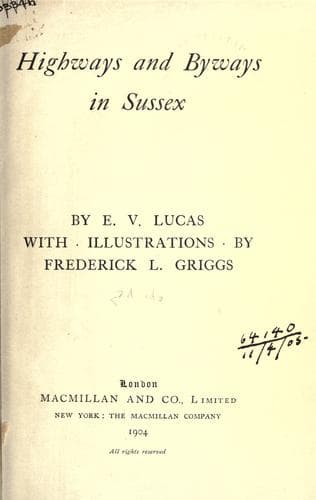
Highways and Byways in SussexLucas, E. V. (Edward Verrall)
History
Highways and Byways in Sussex
Lucas, E. V. (Edward Verrall)
Sussex (England) -- Description and travel
From Horeham Road station, next Heathfield on the way to Hailsham, we
can walk across the country to East Hoathly, and thence to Chiddingly
and Hellingly, where we come to the railway again. ("East Hoathly,
Chiddingly and Hellingly," says a local witticism: "three lies and all
true.") East Hoathly stands high in not very interesting country, nor is
it now a very interesting village. But it is remarkable for an admirably
conducted inn and a church unique (in my experience of old churches) in
its interior for a prettiness that is little short of aggressive.
Whatever paint and mosaic can do to remove plain white surfaces has been
done here, and the windows are gay with new glass. Were the building a
new one, say at Surbiton, the effect would be harmonious; but in an old
village in Sussex it seems a mistake.
[Sidenote: THE CHILD-EATER]
Colonel Thomas Lunsford, of Whyly (now no more), near East Hoathly, a
cavalier and friend of Charles I., was notoriously a consumer of the
flesh of babes. How he won such a reputation is not known, but it never
left him. _Hudibras_ mentions his tastes; in one ballad of the time he
figures as Lunsford that "eateth of children," and in another, recording
his supposed death, he is found with "a child's arm in his pocket."
After a stormy but courageous career he died in 1691, innocent of
cannibalism. It was this Lunsford who fired at his relative, Sir
Nicholas Pelham of Halland, as he was one day entering East Hoathly
church. The huge bullet, the outcome of a long feud, missed Nicholas and
lodged in the church door, where it remained for many years. It cost
Lunsford _£_8,000 and outlawry.
Halland, one of the seats of the Pelhams, about a mile from the
village, was just above Terrible Down, a tract of wild land, on which,
according to local tradition, a battle was once fought so fiercely that
the soldiers were up to their knees in blood. In the neighbourhood it
is, of course, called Tarble Down. Local tradition also states of a
certain piece of woodland attached to the glebe of this parish, called
Breeches Wood, that it owes its name to the circumstance that an East
Hoathly lady, noticing the vicar's breeches to be in need of mending,
presented to him and his successors the wood in question as an endowment
to ensure the perpetual repair of those garments.
Halland House no longer exists, but in the days of the great Duke of
Newcastle, who died in 1768, it was famous for its hospitality and
splendour. We meet with traces of its influence in the frequent
inebriation, after visits there, of Mr. Thomas Turner, a mercer and
general dealer of East Hoathly, who kept a diary from 1764, recording
some of his lapses and other experiences. A few passages from the
extracts quoted in the Sussex Archæological Collections may be given:
Public-domain text, read in full here on John Shaqi.
Reviews
Reviews
No reviews yet
Be the first to share your thoughts on this work.
Elsewhere in the archive
Join the Discussion
Join the discussion
Sign in to leave a comment or review.
Sign InorCreate an account