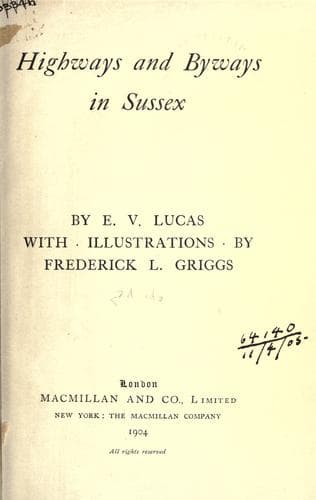
Highways and Byways in SussexLucas, E. V. (Edward Verrall)
History
Highways and Byways in Sussex
Lucas, E. V. (Edward Verrall)
Sussex (England) -- Description and travel
The battle-field was half a mile south of the Abbey, on Telham hill,
where in Harold's day was a hoary apple tree. We have seen William
landing at Pevensey on September 28, 1066: thence he marched to Hastings
"to steal food," and thence, after a delay of a fortnight (to some
extent spent in fortifying Hastings, and also in burning his boats), he
marched to Telham hill. That was on October 13. On the same day Harold
reached the neighbourhood, with his horde of soldiers and armed
rustics, and both armies encamped that night only a mile apart, waiting
for the light to begin the fray. The Saxons were confident and riotous;
the Normans hopeful and grave. According to Wace, "all night the Saxons
might be seen carousing, gambolling, and dancing and singing: _bublie_
they cried, and _wassail_, and _laticome_ and _drinkheil_ and
_drink-to-me_!"
[Illustration: _Battle Abbey, the Gateway._]
At daybreak in the Norman camp Bishop Odo celebrated High Mass, and
immediately after was hurried into his armour to join the fight. As the
Duke was arming an incident occurred but for which Battle Abbey might
never have been built. His suit of mail was offered him wrong side out.
The superstitious Normans standing by looked sideways at each other with
sinking misgiving. They deemed it a bad omen. But William's face
betrayed no fear. "If we win," he said, "and God send we may, I will
found an Abbey here for the salvation of the souls of all who fall in
the engagement." Before quitting his tent, he was careful that those
relics on which Harold had sworn never to oppose his efforts against
England's throne should be hung around his neck.
[Sidenote: TAILLEFER]
So the two armies were ready--the mounted Normans, with their conical
helmets gleaming in the hazy sunlight, with kite-shaped shields, huge
spears and swords; the English, all on foot, with heavy axes and clubs.
But theirs was a defensive part; the Normans had to begin. It fell to
the lot of a wild troubadour named Taillefer to open the fight. He
galloped from the Norman lines at full speed, singing a song of heroes;
then checked his steed and tossed his lance thrice in the air, thrice
catching it by the point. The opposing lines silently wondered. Then he
flung it at a luckless Saxon with all the energy of a madman, spitting
him as a skewer spits a lark. Taillefer had now only his sword left.
This also he threw thrice into the air, and then seizing it with the
grip of death he rode straight at the Saxon troops, dealing blows from
left to right, and so was lost to view.
Public-domain text, read in full here on John Shaqi.
Reviews
Reviews
No reviews yet
Be the first to share your thoughts on this work.
Elsewhere in the archive
Join the Discussion
Join the discussion
Sign in to leave a comment or review.
Sign InorCreate an account