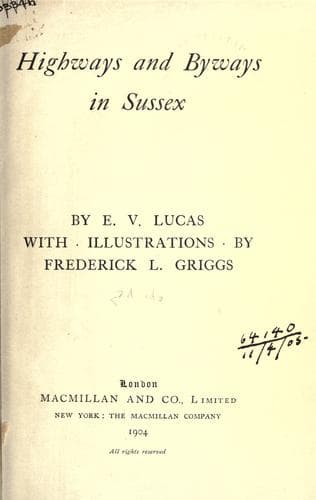
Highways and Byways in SussexLucas, E. V. (Edward Verrall)
History
Highways and Byways in Sussex
Lucas, E. V. (Edward Verrall)
Sussex (England) -- Description and travel
At Wadhurst are many iron grave slabs and a graceful slender spire. The
massive door bears the date 1682. A high village, in good accessible
country, discovery seems to be upon it. London is not so near as at
Crowborough; but one may almost hear the jingling of the cabs.
FOOTNOTE:
[3] Weever's _Funeral Monuments_.
CHAPTER XL
TUNBRIDGE WELLS
Over the border--The beginnings of the wells--Tunbridge Wells
to-day--Mr. George Meredith--The Toad and other
rocks--Eridge--Trespassing in Sussex--Saxonbury--Bayham
Abbey--Lamberhurst--Withyham--The Sackvilles--A domestic
autocrat--"To all you ladies now on land"--Withyham church--The
Sackville monument--John Waylett--Beer and bells--Parish
expenses--Buckhurst and Old Buckhurst--Ashdown Forest--Hartfield
and Bolebroke--A wild region.
I have made Tunbridge Wells our last centre, because it is convenient;
yet as a matter of strict topography, the town is not in Sussex at all,
but in Kent.
In that it is builded upon hills, Tunbridge Wells is like Rome, and in
that its fashionable promenade is under the limes, like Berlin; but in
other respects it is merely a provincial English inland pleasure town
with a past: rather arid, and except under the bracing conditions of
cold weather, very tiring in its steepnesses. No wonder the small
victoria and smaller pony carriage so flourish there.
[Illustration: _The Pantiles, Tunbridge Wells._]
The healthful properties of Tunbridge Wells were discovered, as I record
a little later, in 1606; but it was not until Henrietta Maria brought
her suite hither in 1630 that the success of the new cure was assured.
Afterwards came Charles II. and his Court, and Tunbridge Wells was made;
and thenceforward to fail to visit the town at the proper time each year
(although one had the poorest hut to live in the while) was to write
one's self down a boor. A more sympathetic patron was Anne, who gave
the first stone basin for the spring--hence "Queen's Well"--and whose
subscription of _£_100 led to the purchase of the pantiles that paved the
walk now bearing that name. Subsequently it was called the Parade, but
to the older style everyone has very sensibly reverted.
Tunbridge Wells is still a health resort, but the waters no longer
constitute a part of the hygienic routine. Their companion element, air,
is the new recuperative. Not that the spring at the foot of the Pantiles
is wholly deserted: on the contrary, the presiding old lady does quite a
business in filling and cleaning the little glasses; but those visitors
that descend her steps are impelled rather by curiosity than ritual, and
many never try again. Nor is the trade in Tunbridge ware, inlaid work in
coloured woods, what it was. A hundred years ago there was hardly a girl
of any pretensions to good form but kept her pins in a Tunbridge box.
Public-domain text, read in full here on John Shaqi.
Reviews
Reviews
No reviews yet
Be the first to share your thoughts on this work.
Elsewhere in the archive
Join the Discussion
Join the discussion
Sign in to leave a comment or review.
Sign InorCreate an account