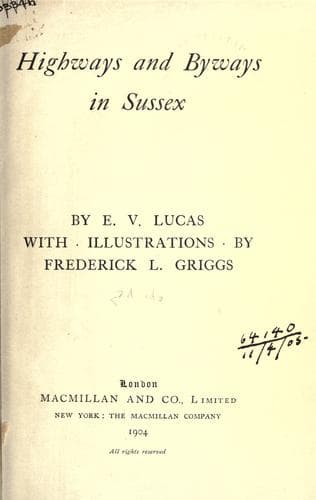
Highways and Byways in SussexLucas, E. V. (Edward Verrall)
History
Highways and Byways in Sussex
Lucas, E. V. (Edward Verrall)
Sussex (England) -- Description and travel
Ink-horn (Inkstand): "Fetch me down de inkhorn, mistus; I be g'wine to
putt my harnd to dis here partition to Parliament. 'Tis agin de Romans,
mistus; for if so be as de Romans gets de upper harnd an us, we shall be
burnded, and bloodshedded, and have our Bibles took away from us, and
dere'll be a hem set out."
Justabout (Certainly, extremely): "I justabout did enjoy myself up at
the Cristial Palace on the Forresters' day, but there was a terr'ble
gurt crowd; I should think there must have been two or three hundred
people a-scrouging about."
Know (Used as a substantive for knowledge): "Poor fellow, he has got no
know whatsumdever, but his sister's a nice knowledgeable girl."
Lamentable (Very): This word seems to admit of three degrees of
comparison, which are indicated by the accentuation, thus:--
[Sidenote: POSITIVE, COMPARATIVE, SUPERLATIVE]
_Positive_--Lamentable (as usually pronounced).
_Comparative_--Larmentable.
_Superlative_--Larmentȧȧble.
"'Master Chucks,' he says to me says he, ''tis larmentable purty
weather, Master Crockham.' 'Larmentȧȧble!' says I."
Larder (Corruption of ladder): "Master's got a lodge down on the land
yonder, and as I was going across t'other day-morning to fetch a larder
we keeps there, a lawyer catched holt an me and scratched my face."
(Lawyer: A long bramble full of thorns, so called because, "When once
they gets a holt on ye, ye dȯȧnt easy get shut of 'em.")
Leetle (diminutive of little): "I never see one of these here gurt men
there's s'much talk about in the pėȧpers, only once, and that was up at
Smiffle Show adunnamany years agoo. Prime minister, they told me he was,
up at Lunnon; a leetle, lear, miserable, skinny-looking chap as ever I
see [Disraeli, I imagine]. 'Why,' I says, 'we dȯȧn't count our minister
to be much, but he's a deal primer-looking than what yourn be.'"
Loanst (A loan): "Will you lend mother the loanst of a little tea?"
Master (Pronounced Mass). The distinctive title of a married labourer. A
single man will be called by his Christian name all his life long; but a
married man, young or old, is "Master" even to his most intimate friend
and fellow workmen, as long as he can earn his own livelihood; but as
soon as he becomes past work he turns into "the old gentleman," leaving
the bread-winner to rank as master of the household. "Master" is quite a
distinct title from "Mr." which is always pronounced Mus, thus: "Mus"
Smith is the employer. "Master" Smith is the man he employs. The old
custom of the wife speaking of her husband as her "master" still lingers
among elderly people; but both the word and the reasonableness of its
use are rapidly disappearing in the present generation. It may be
mentioned here that they say in Sussex that the rosemary will never
blossom except where "the mistus" is master.
Public-domain text, read in full here on John Shaqi.
Reviews
Reviews
No reviews yet
Be the first to share your thoughts on this work.
Elsewhere in the archive
Join the Discussion
Join the discussion
Sign in to leave a comment or review.
Sign InorCreate an account