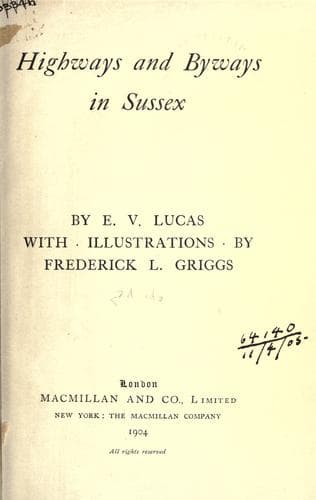
Highways and Byways in SussexLucas, E. V. (Edward Verrall)
History
Highways and Byways in Sussex
Lucas, E. V. (Edward Verrall)
Sussex (England) -- Description and travel
The beginnings of Steyning are lost in the distance. Its church was
founded, probably in the eighth century, by St. Cuthman, an early
Christian whose adventures were more than usually quaint. He began by
tending his father's sheep, with which occupation his first miracle was
associated. Being called one day to dinner, and having no one to take
his place as shepherd, he drew a circle round the flock with his crook,
and bade the sheep, in the name of the Lord, not to stray beyond it. The
sheep obeyed, and thenceforward on repeating the same manoeuvre he
left them with an easy mind. In course of time his father died, and
Cuthman determined to travel; intense filial piety determined him to
take his aged mother with him. In order to do this he constructed a
wheelbarrow couch, which he partly supported by a cord over his
shoulders. Thus united, mother and son fared forth into the cold world;
which was, however, warmed for them by the watchful interest taken in
Cuthman by a vigilant Providence. One day, for example, the cord of the
barrow broke in a hayfield, where Cuthman, who supplied its place by
elder twigs, was the subject of much ridicule among the haymakers.
Immediately a heavy storm broke over the field, destroying the crop; and
not only then, but ever afterwards in the same field--possibly to this
day--has haymaking been imperilled by a similar storm. So runs the
legend.
The second occasion on which the cord broke and let down Cuthman's
mother was at Steyning. Cuthman took the incident as a divine intimation
that the time had come to settle, and he thereupon first built for his
mother and himself a hut and afterwards a church. The present church
stands on its site. Cuthman was buried there. So, also, was Ethelwulf,
father of Alfred the Great, whose body afterwards was moved to
Winchester. Alfred the Great had estates at Steyning, as elsewhere in
Sussex.
While Cuthman was building his church a beam shifted, making a vast
amount of new labour necessary. But as the Saint sorrowfully was
preparing to begin again, a stranger appeared, who pointed out how the
mischief could be repaired in a more speedy manner and with less toil.
Cuthman and his men followed his instructions, and all was quickly well
again. Cuthman thereupon fell on his knees and asked the stranger who he
was. "I am He in whose name thou buildest this temple," he replied, and
vanished.
[Illustration: _Steyning Church._]
The present church, which stands on the site of St. Cuthman's, is only a
reminder of what it must have been in its best days. When one faces the
curiously chequered square tower, an impression of quiet dignity is
imparted; but a broadside view is disappointing by reason of the high
deforming roof, giving an impression as of a hunched back. (One sees the
same effect at Udimore, in the east of Sussex.) Within are two rows of
superb circular arches, with zigzag mouldings, on massive columns.
[Sidenote: STEYNING AND HISTORY]
Public-domain text, read in full here on John Shaqi.
Reviews
Reviews
No reviews yet
Be the first to share your thoughts on this work.
Elsewhere in the archive
Join the Discussion
Join the discussion
Sign in to leave a comment or review.
Sign InorCreate an account