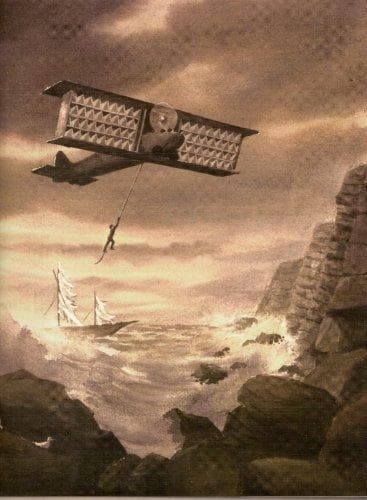
Hike was glad to let him take the levers. Creeping back to the
freight-platform, and covering himself with a fold of the tarpaulin
against the piercing night-wind, he shivered off to sleep; worrying a
little over the wounded men; hoping they were not killed; picturing
the glorious excitement of a game on the athletic field at Santa
Benicia, where they fought their best, but did not try to kill each
other, to leave each other a mass of dead flesh on the field.
For the first time, Hike really understood that war is a horrible
thing, to be prevented as far as possible. He remembered a friend of
his father’s, a brave, high-ranking officer and a good commander,
who had often said that war was a crime, which the Army ought to
prevent, instead of trying to bring it on. He was glad, as he lay
there thinking, that he was with a man like Lieutenant Adeler, who
also hated war, and who was coming down here not to make war, but to
prevent the treacherous fighting of Welch. Welch was the sort of man
who liked to bring about war.
He hoped that the tetrahedral, as used by the Army, would be so
terrible a thing that it would prevent other nations from making war.
With the picture of the poor greasers, and a couple of Americans,
writhing on the ground, mowed down by the machine-gun, bloody and in
agonized pain, Hike prayed, simply and sincerely, for the end of all
war.
He was not afraid. He was ready for the struggle about the ranch at
Aguas Grandes. But he hoped that that struggle would end the warring
of Welch.
He understood now something that Jack Adeler had said: that some day,
before long, he hoped that the whole Army would be busy with great
engineering, with building Panama canals, and stringing wires, and
setting up wireless-stations, and making great forests, instead of
preparing for fighting.
That, too, was what Hike wanted to do. He hoped, some day before
long, to be an engineer, in good, stout laced leather boots and a
sombrero, building a fine big steel bridge across some dangerous
pass in the High Sierras, with the good open air and the deep woods
about him. He planned to know wireless and aeroplanes and steel—and
he hoped that every new thing he did, every fine bridge or aeroplane
that he built, would be one step toward making a more civilized
world, which would not want war; which would prefer happiness and
peace and the good brave mountain woods to fighting like clay-grimed
savages.
It was the first time that Hike really knew how serious he could be.
He didn’t feel much like a gay Santa Benicia boy, just then.
At last, exhausted, he fell asleep. He was awakened by the stopping
of the motor, and, in the gray light of early dawn, saw that they
were circling over a group of adobe buildings, with cattle corrals
about, while a bunch of men were shouting, “He’s here! Adeler’s here!”
They were at Aguas Grandes.
CHAPTER XXIV
A SKIRMISH AT AGUAS GRANDES
Public-domain text, read in full here on John Shaqi.
Reviews
Reviews
No reviews yet
Be the first to share your thoughts on this work.
Elsewhere in the archive
Join the Discussion
Join the discussion
Sign in to leave a comment or review.
Sign InorCreate an account