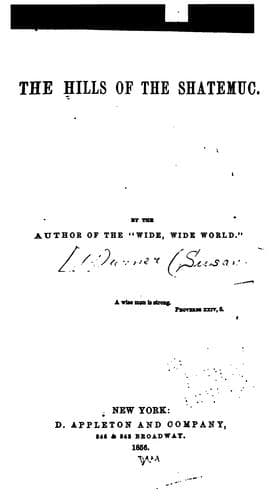
Children -- Death -- Juvenile fiction; Conduct of life -- Juvenile fiction; Farm life -- Juvenile fiction; Siblings -- Juvenile fiction
That year came to its end, not only the solar but the
collegiate. Rufus took his degree brilliantly; was loaded with
compliments; went to spend a while at home, and then went to
Mannahatta; to make some preparatory arrangements for entering
upon a piece of employment to which President Tuttle had
kindly opened him a way. Winthrop changed his form in the
grammar school for the Junior Greek class, which happened to
be left without any teacher by the removal of the Greek
professor to the headship of another College. To this charge
he proved himself fully competent. It made the same breaches
upon his time, and gave him rather more amends than his form
in the grammar school. And amid his various occupations,
Winthrop probably kept himself warm without a new overcoat;
for he had none.
It was difficult at home, by this time, to do more than make
ends meet. They hardly did that. The borrowed hundreds were of
necessity yet unpaid; there was interest on them that must be
kept down; and the failure of Rufus and Winthrop from the farm
duty told severely upon the profits of the farm; and that
after it had told upon the energies and strength of the whole
little family that were left behind to do all that was done.
There was never a complaint nor a regret, even to each other;
much less to those for whom they toiled; but often there _was_ a
shadowed look, a breath of weariness and care, that spoke from
husband to wife, from parent to child, and nerved -- or
unnerved them. Still, Rufus had graduated; he was a splendid
young man; all, as well as the parents' hearts, knew that; and
Winthrop, -- he was never thought of, their minds and speech
never went out to him, but the brows unbent, the lips relaxed,
and their eyes said that their hearts sat down to rest.
Winthrop? He never could do anything but well; he never had
since he was a child. He would take his degree now in a few
months and he would take it honourably; and then he would be
off to the great city -- that was said with a throe of pain and
joy! -- and there he would certainly rise to be the greatest of
all. To their eyes could he ever be anything else? But they
were as certain of it as Winthrop himself; and Winthrop was
not without his share of that quality which Dr. Johnson
declared to be the first requisite to great undertakings;
though to do him justice the matter always lay in his mind
without the use of comparatives or superlatives. And while
they sat round the fire talking of him, and of Rufus, the
images of their coming success quite displaced the images of
weary days and careful nights with which that success had been
bought.
It was not however to be quite so speedily attained as they
had looked for.
The time of examination came, and Winthrop passed through it,
as President Tuttle told his father, "as well as a man could;"
and took honours and distinctions with a calm matter-of-fact
manner, that somehow rather damped the ardour of
congratulation.
Public-domain text, read in full here on John Shaqi.
Reviews
Reviews
No reviews yet
Be the first to share your thoughts on this work.
Elsewhere in the archive
Join the Discussion
Join the discussion
Sign in to leave a comment or review.
Sign InorCreate an account