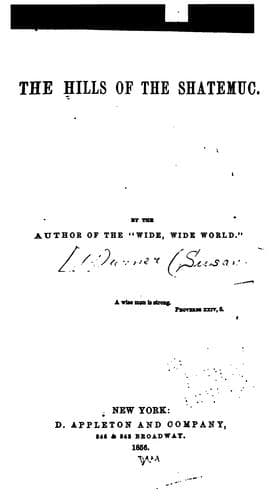
Children -- Death -- Juvenile fiction; Conduct of life -- Juvenile fiction; Farm life -- Juvenile fiction; Siblings -- Juvenile fiction
"You are drawing a distinction in one breath which you
confound in the next," said Elizabeth.
"I didn't know that you would detect it," he said with a half
smile.
"Detect what?"
"The distinction between business and pleasure."
"Do you think I don't know the difference?"
"You cannot know the difference, without knowing the things to
be compared."
"The things to be compared! --" said she, with a good look at
him out of her dark eyes. "And which of them do you think I
don't know?"
"I supposed you were too busy to have much time for pleasure,"
he said quietly.
"It is possible to be busy in more ways than one," said
Elizabeth, after a minute of not knowing how to take him up.
"That is just what I was thinking."
"What are _you_ busy about, Mr. Landholm, in this place of
business?"
"I am only learning my trade," he answered.
"A trade! -- May I ask what?" she said, with another surprised
and inquisitive look.
"A sort of cobbling trade, Miss Elizabeth -- the trade of the
law."
"What does the law cobble?"
"People's name and estate."
"_Cobble?_" said Elizabeth. "What is the meaning of 'cobble?'"
"I don't recollect," said Winthrop. "What meaning do you give
it, Miss Haye?"
"I thought it was a poor kind of mending."
"I am afraid there is some of that work done in the
profession," said Winthrop smiling. "Occasionally. But it is
the profession and not the law that is chargeable, for the
most part."
"I wouldn't be a lawyer if that were not so," said Elizabeth.
"I wouldn't be a _cobbler_ of anything."
"To be anything else might depend on a person's faculties."
"I don't care," said Elizabeth, -- "I _would_ not be. If I could
not mend, I would let alone. I wouldn't cobble."
"What if one could neither mend nor let alone?"
"One would have less power over himself than I have, or than
you have, Mr. Landholm."
"One thing at least doesn't need cobbling," he said with a
smile.
"I never heard such a belittling character of the profession,"
she went on. "Your mother would have given it a very different
one, Mr. Landholm. She would have told you, 'Open thy mouth,
judge' -- what is it? -- 'and plead the cause of the poor.'"
Whether it were the unexpected bringing up of his mother's
name, or the remembrance of her spirit, something procured
Miss Elizabeth a quick little bright smile of answer, very
different from anything she had had from Winthrop before. So
different, that her eyes went down to her work for several
minutes, and she forgot everything else in a sort of wonder at
the change and at the beauty of expression his face could put
on.
"I didn't find those words myself," she added presently; -- "a
foolish man was shewing me the other day what he said was my
verse in some chapter of Proverbs; and it happened to be
that."
But Winthrop's answer went to something in her former speech,
for it was made with a little breath of a sigh.
"I think Wut-a-qut-o is a pleasanter place than this, Miss
Haye."
Public-domain text, read in full here on John Shaqi.
Reviews
Reviews
No reviews yet
Be the first to share your thoughts on this work.
Elsewhere in the archive
Join the Discussion
Join the discussion
Sign in to leave a comment or review.
Sign InorCreate an account