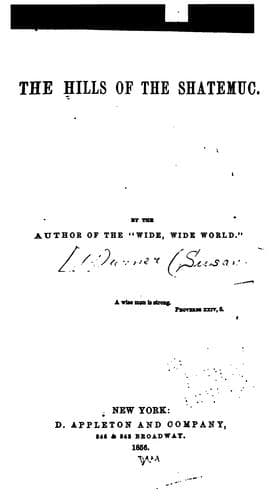
Children -- Death -- Juvenile fiction; Conduct of life -- Juvenile fiction; Farm life -- Juvenile fiction; Siblings -- Juvenile fiction
"Why should Winthrop Landholm be helped," said Rose, "more
than all the other young men who are studying in the city?"
"Because I know him," said Elizabeth, "and don't happen to
know the others. And because I like him."
"I like him too," said her father yawning, "but I don't know
anything very remarkable about him. I like his brother the
best."
"He is honest, and good, and _independent_," said Elizabeth;
"and those are the very people that ought to be helped."
"And those are the very people that it is difficult to help,"
said her father. "How do you suppose he would take it, if I
were to offer him a fifty dollar note to-morrow?"
"I don't suppose he would take it at all," said Elizabeth.
"You couldn't help him so. But there are other ways."
"You may give him all your business, when he gets into his
profession," said Mr. Haye. "I don't know what else you can
do. Or you can use your influence with Mr. Satterthwaite to
get his father to employ him."
"You and he may both be very glad to do it yet," said
Elizabeth. "I shouldn't wonder."
"Then I don't see why you are concerned about him," said Rose.
Elizabeth was silent, with a face that might be taken to say
there was nobody within hearing worthy of her words.
Rufus went back to his work in the mountains, and Winthrop
struggled on; if most diligent and unsparing toil, and patient
denying himself of necessary and wished-for things, were
struggling. It was all his spare time could do to make clear
the way for the hours given to his profession. There was
little leisure for rest, and he had no means to bestow on
pleasure; and that is a very favourable stating of the case as
far as regards the last item. Mr. Inchbald never asked for
rent, and never had it; not in those days. That the time would
come, Winthrop believed; and his kind host never troubled
himself to inquire.
There were pleasures, however, that Winthrop could not buy and
which were very freely his. Mr. Herder's friendship introduced
him to society, some of the best worth to be found, and which
opened itself circle after circle to let him in. He had the
freedom of President Darcy's house, and of Mr. Haye's, where
he met other sets; in all, covering the whole ground of
Mannahatta good society; and in all which Winthrop could not
but know he was gladly seen. He had means and facilities for
social enjoyment, more, by many, than he chose to avail
himself of; facilities that did not lack temptation. In Mr.
Herder's set, Winthrop often was found; other houses in the
city saw him but rarely.
Public-domain text, read in full here on John Shaqi.
Reviews
Reviews
No reviews yet
Be the first to share your thoughts on this work.
Elsewhere in the archive
Join the Discussion
Join the discussion
Sign in to leave a comment or review.
Sign InorCreate an account