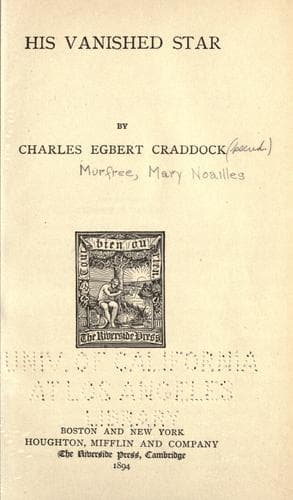
Alcohol trafficking -- Fiction; Mountain life -- Tennessee -- Fiction
Whenever he thought of Larrabee outside, triumphant, free, enjoying
an absolute immunity from the law by reason of the destruction of the
moonshiners' lair, which rendered the discovery of his complicity
impossible, Taft frowned heavily and swore beneath his breath, and
kicked the unoffending embers into a new adjustment, so bitter was the
fact that his own safety made Larrabee's protection complete. Even poor
Dan Sykes's exile--and doubtless the young sot was well on the way to
Texas by this time--was as necessarily a measure taken in Larrabee's
behalf as if it were the dearest desire of Taft's heart to shield and
screen him. The realization that, despite himself, Larrabee shared his
security cheapened it. Less and less he realized its value. A turbulent
pulse began to stir within his veins. His heavy cheek was red and
pendulous beneath his yellow beard. Occasionally he dropped his lower
jaw with an expression of angry dismay, so ill had the event fallen out
with his liking. The sight of Copley wandering about the half-darkened
house, lighted only by the fire and the pallid grayness from the door
ajar opening upon the rainy outside world, as uneasy as a homeless cat,
able to settle to nothing, his face a palimpsest of care and trouble
and failure, overwritten again and again above the half-obliterated
script of years agone, irritated him vaguely. Taft eyed him loweringly,
as the two children in the opposite room besieged him for the detail of
the adventures and dramatic "taking off" of a certain "black b'ar," a
vanquished enemy of his earlier days, which he recounted as aimlessly
as if the story were elicited by a wooden crank; but responding to a
spirited encore, he plucked up heart of grace to add new and fresh
particulars. His worn and not unkindly face did not ill become the
armchair and the propinquity of the juvenile heads. His serenity, as
the two resorted from contradiction to blows, smartly administered
across him to his own great jeopardy, bespoke a grandfatherly
tolerance, nearly related to affection, for the combatants. Without
more masterful leading than his own mind could originate or his own
propensities could furnish, he might spend the rest of his life at the
plough-handles, and ask no better society, and hope for naught beyond
his coarse garb and his coarser fare. He was growing old, and this
might be a better prospect than the still could promise, with always
the possibility of a federal prisoner's cell at the vanishing point of
the long perspective.
Public-domain text, read in full here on John Shaqi.
Reviews
Reviews
No reviews yet
Be the first to share your thoughts on this work.
Elsewhere in the archive
Join the Discussion
Join the discussion
Sign in to leave a comment or review.
Sign InorCreate an account