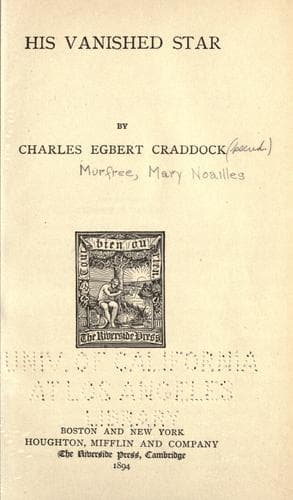
Alcohol trafficking -- Fiction; Mountain life -- Tennessee -- Fiction
Kenniston was looking out of the door, with that sullen sense of
injury and hopelessness which oppresses a city man in the country
in bad weather. The world had slipped away, somehow; he was left to
the vague unresponsiveness of the inexpressive white mists; the rain
would probably continue forever; the day was of a longevity known to
no other that had ever dawned; without the prompting of his watch he
could not have said if it were morning or afternoon. The roof leaked;
the boots of his uncouth visitors tracked up the floor with red clay
mud. A saddle in one corner gave out an obtrusive odor of leather,
and the monkey stove, despite all this dankness, filled the room with
that baking, dry, afflicting aroma common to all its kindred. His
pugnacity was abated under these untoward conditions; his enthusiasms
were overwhelmed beneath the depression of the rain. He thought
wistfully of Bretonville, and of a cosy corner in the reading-room of
a certain club, and of his office, and sighed as his mind reverted to
the jeopardy of the present, the futility of the money and thought he
had spent here, and the froward tangle which must needs be untwisted if
these unpromising assets were to be utilized at all.
"Mus' hev been Lar'bee an' Espey a-moonshinin'." Taft once more sought
to prompt that inimical sense of injury. "An' moved the boulder
bodaciously,--the corner landmark."
"A felony," said Kenniston thoughtfully.
The patter of the rain came heavily through the silence, and in that
bleak whiteness without they heard far away the wind rousing from its
lair in furthest denies. The terrors of its voice did not shake the
mists; only the sound touched a responsive chord of feeling, and the
day was the drearier for the broken stillness.
"A felony," he said, and fell a-musing. He vaguely repudiated the
idea, and then bethought himself, contradictorily, of the strange
subterfuge with which he had been summoned to the door. For no harm,
surely, he argued. There was a certain fascination in the thought of
the new star that the mountaineer had brought to his contemplation. Not
a bad face, this star-gazer's, and with a coloring which had always
commended itself to his artistic sense. A good face and finely cut, he
would have said but for that association of ideas, "a felony," that
sudden conscious expression as of some guilty knowledge of the burning
of the hotel. He could not believe it of his star-gazer, with his
elated upward look! He remembered afterward that he thought then that
the dankness of the weather, in relaxing all manner of tension, had
slackened his rigid standards and his taut personal exactions. He was
morally limp, doubtless, as well as physically; but he shrunk from the
phrase in this application, and he considered that the most definite
sensation of that most indefinite day was the relief he experienced
when Rodolphus Ross came plunging out of the mists.
Public-domain text, read in full here on John Shaqi.
Reviews
Reviews
No reviews yet
Be the first to share your thoughts on this work.
Elsewhere in the archive
Join the Discussion
Join the discussion
Sign in to leave a comment or review.
Sign InorCreate an account