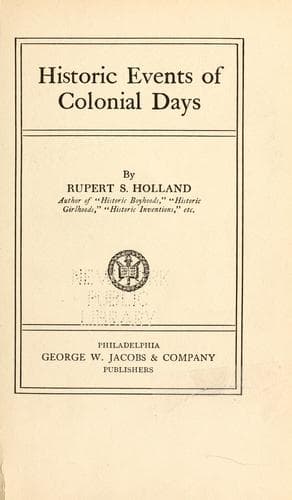
Historic Events of Colonial DaysHolland, Rupert Sargent
History
Historic Events of Colonial Days
Holland, Rupert Sargent
United States -- History -- Colonial period, ca. 1600-1775
He returned to Fort Diego, and ordered Colonel Palmer, with over two
hundred Scotchmen and Indians to march to Fort Moosa and scout through
the woods to prevent any communication between St. Augustine and the
interior of Florida. Colonel Palmer was told to camp each night in a new
place, to avoid battle, and to return at once if a larger force than his
own appeared. Another officer was sent with the Carolina soldiers to
take Point Quartell, which was about a mile distant from the castle of
St. Augustine, and build a battery there to command the northern
entrance to the harbor.
The general himself set out to capture the Spaniards' battery at
Anastasia, and by clever maneuvers there succeeded in driving the enemy
to their boats. Oglethorpe set up cannon and sent an envoy to the
Spanish governor, calling on him to surrender. The Spaniard replied that
he should be glad to shake hands with General Oglethorpe if the latter
would come to him in his castle. In answer Oglethorpe opened fire from
his new battery, but the distance to the town was too great for his guns
and little harm was done the enemy.
Colonel Palmer, meantime, disregarding the general's orders to camp in a
new place each night, had kept his men in the partly demolished Fort
Moosa. The Spaniards sent six hundred men to attack his small force.
Palmer's soldiers resisted desperately, but the Highlanders and the
Indians were too much outnumbered by the Spaniards; half of them,
including Colonel Palmer, were killed, a few escaped, and the rest were
made prisoners.
The commander of the fleet also disregarded the arrangement he had made
with Oglethorpe and ordered off the war-ship stationed outside the
harbor, with the result that several sloops from Havana with new troops
and provisions stole into the channel and reached the Spanish
stronghold. The garrison at St. Augustine had begun to feel the pinch of
hunger and might soon have surrendered, but these fresh supplies tided
them over and enabled them to keep up their defense.
General Oglethorpe, discouraged in his plan of a blockade, decided to
make one more attempt at carrying the town by assault. The British
commodore, Pearse, was to attack with his fleet while Oglethorpe led his
soldiers by land. The colonial troops and Indians were ready to open
fire, and only waited the signal from the ships. They waited in vain,
however. Instead of keeping his agreement, Commodore Pearse quietly
sailed away with all his ships, sending word to General Oglethorpe that
it was now the season when hurricanes might be expected off the Florida
coast and that he didn't intend to risk His Majesty's fleet there any
longer.
Public-domain text, read in full here on John Shaqi.
Reviews
Reviews
No reviews yet
Be the first to share your thoughts on this work.
Elsewhere in the archive
Join the Discussion
Join the discussion
Sign in to leave a comment or review.
Sign InorCreate an account