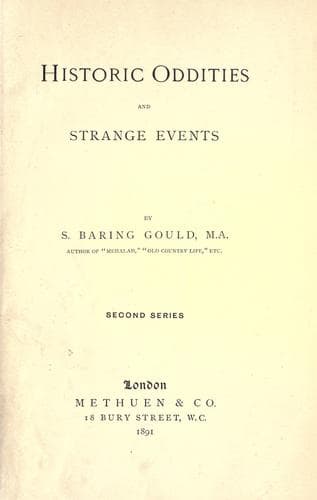
Historic Oddities and Strange EventsBaring-Gould, S. (Sabine)
History
Historic Oddities and Strange Events
Baring-Gould, S. (Sabine)
History; Mysticism; Patarines
Then the Count went upstairs to the laundry, which was on the highest
storey, and where were also some rooms. The Countess was particular
about her lace and linen, and often attended to them herself, getting up
some of the collars and frills with her own hands. She was not in the
laundry. Evidently she was, as Stauff had said, not at home. The Count
questioned the manservant. Had his mistress intimated her intention of
supping abroad? No, she had not. Nevertheless, it was possible she might
have gone to intimate friends. Accordingly, he sent to the palace of
Prince Wittgenstein, and to the house of Councillor von Storch, to
inquire if she were at either. She had been seen at neither.
The Count was puzzled, without, however, being seriously alarmed. He
bade Stauff call the valet, Schiller, and the coachman, Schämbs, who
slept out of the house, and then go for a locksmith. Stauff departed.
Presently the valet and coachman arrived, and, after, Stauff, without
the locksmith, who, he said, was ill, and his man was at the tavern. The
Count was angry and scolded. Then the coachman went forth, and soon came
back with the locksmith's apprentice, who was set at once to open the
locked doors in the top storey. The Countess was not in them. At the
same time the young man noticed a smell of burning, but whence it came
they could not decide. Thinking that this smell came from the kitchen on
the first storey--that is, the floor above where the Count lived--they
attacked the door of the kitchen, which was also locked. She was not
there. Then the Count led the way to the private sitting-room of the
Countess. As yet only the young locksmith had noticed the fire, the
others were uncertain whether they smelt anything unusual or not. The
key of the apprentice would not fit the lock of the Countess' ante-room,
so he ran home to get another. Then the Count went back to his own
apartment, and on entering it, himself perceived the smell of burning.
Accordingly, he went upstairs again, to find that the coachman had
opened an iron stove door in the passage, and that a thick pungent smoke
was pouring out of it. We must enter here into an explanation. In many
cases the porcelain stove of a German house has no opening into the
room. It is lighted outside through a door into the passage. Several
stoves communicate with one chimney. The Count and his servants ran out
into the courtyard to look at the chimney stack to see if smoke were
issuing from it. None was. Then they returned to the house. The
apprentice had not yet returned. Looking through the glass door, they
saw that there was smoke in the room. It had been unperceived before,
for it was evening and dusk. At once the Count's valet, Schiller,
smashed the plate glass, and through the broken glass smoke rolled
towards them.
Public-domain text, read in full here on John Shaqi.
Reviews
Reviews
No reviews yet
Be the first to share your thoughts on this work.
Elsewhere in the archive
Join the Discussion
Join the discussion
Sign in to leave a comment or review.
Sign InorCreate an account