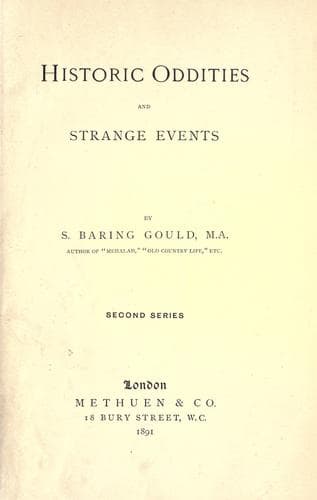
Historic Oddities and Strange EventsBaring-Gould, S. (Sabine)
History
Historic Oddities and Strange Events
Baring-Gould, S. (Sabine)
History; Mysticism; Patarines
The reader may remember that the window of the inner boudoir did not
look into the Neckar Street, but into a small side street. Immediately
opposite lived a widow lady named Kekule. On the evening in question,
her daughter, Augusta, a girl of eighteen, came in from a walk, and went
upstairs to the room the window of which was exactly opposite, though at
a somewhat higher level than the window of the boudoir. Looking out of
her window, Augusta Kekule saw to her astonishment a flickering light
like a lambent flame in the boudoir. A blind was down, so that she could
see nothing distinctly. She was, however, alarmed, and called her
brother Augustus, aged twenty years, and both watched the flames
flashing in the room. They called their mother also, and all three saw
it flare up high, then decrease, and go out. The time was 8.15. On
examination of the spot, it was seen that the window of Miss Kekule
commanded the corner of the boudoir, where was the divan partly burnt
through in several places.
What was the meaning of these two appearances, the smoke and the flame?
Apparently, from half-past seven to half-past eight the murderer was
engaged in burning the body, and in effacing with fire the blood-stains
on the sofas. During this time John Stauff was in the house, and, beside
the Countess, alive or dead, John Stauff only.
Stauff was now subjected to examination. He was required to account for
his time on the afternoon and evening of Sunday, June 13.
He said, that after his return from the palace, that is, about ten
minutes past three, he went into his room on the basement, and ate bread
and cheese. When told that the wife of Schiller stated she had seen him
come downstairs, he admitted that he had run upstairs to fetch a duster,
to brush away the bread crumbs from the table at which he had eaten.
After the woman left, according to his own account, he remained in his
room below till five o'clock, when the Countess came to the head of the
stairs and called him. He went up and found her on the topmost landing;
she went into the laundry, and he stood in the door whilst she spoke to
him, and gave him some orders for the butcher and baker. She wore, he
said, a black stuff gown. Whilst he was talking to her, Schämbs drove
away to fetch the Count. He gave a correct account of what followed, up
to the departure of the Count on his walk. After that, he said, he had
written a letter to his sweetheart, and at eight went out to get his
supper at an outdoor restaurant where he remained till half-past nine.
He was unable to produce evidence of anyone who had seen him and spoken
to him there; but, of course, much cannot be made of this, owing to the
distance of time at which the evidence was taken from the event of the
murder. According to his account, therefore, no one was in the house at
the time when the smoke rose from the chimney, and the flame was seen in
the boudoir.
Public-domain text, read in full here on John Shaqi.
Reviews
Reviews
No reviews yet
Be the first to share your thoughts on this work.
Elsewhere in the archive
Join the Discussion
Join the discussion
Sign in to leave a comment or review.
Sign InorCreate an account