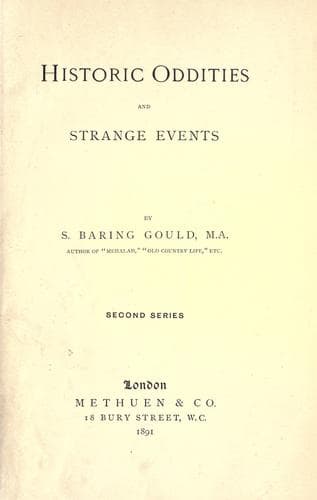
Historic Oddities and Strange EventsBaring-Gould, S. (Sabine)
History
Historic Oddities and Strange Events
Baring-Gould, S. (Sabine)
History; Mysticism; Patarines
On September 1, 1848, on the fourth day after Stauff knew that he was
charged with the murder of the Countess, he asked to make his statement
of what really took place. This was the account he gave. It will be seen
that, from the moment he knew the charge of murder was brought against
him, he altered his defence.
He said, "On June 20, 1847," (that is, a week after the murder), "about
ten o'clock in the evening, after the Count had partaken of his supper
and undressed, he brought me a box containing jewelry, and told me he
would give it to me, as I was so poor, and that it would place my father
and me in comfortable circumstances. I then told the Count that I did
not know what to do with these jewels, whereupon he exhorted me to send
them to my father, and get him to dispose of them. He told me that he
required me solemnly to swear that I would not tell anyone about the
jewels. I hid the box in a stocking and concealed it in some bushes on
the Bessungen road. Later I told my brother Jacob where they were, and
bade him give them to my father on his visit to Darmstadt."
When Stauff was asked what reason he could assign for the Count giving
him the jewels, he said that the Count saw that he, John Stauff,
suspected him of the murder, and he named several circumstances, such as
observing blood on the Count's handkerchief on the evening of the
murder, which had led him to believe that the Count was guilty, and the
Count was aware of his suspicions.
On March 4, 1850, began the trial of John Stauff for the murder of the
Countess, for robbery, for arson, and for attempt to poison the Count.
At the same time his father, Henry Stauff, and his brother, Jacob
Stauff, were tried for concealment of stolen goods. The trial came to an
end on April 11. As many as 118 witnesses were heard; among these was
the Count Goerlitz, as to whose innocence no further doubts were
entertained.
John Stauff was at that time aged twenty-six, he was therefore
twenty-four years old at the time of the murder. He had been at school
at Oberohmen, where he had shown himself an apt and intelligent scholar.
In 1844 he had entered the grand-ducal army, and in May 1846 had become
servant in the Goerlitz house, as footman to the Countess. In his
regiment he had behaved well; he had been accounted an excellent
servant, and both his master and mistress placed confidence in him.
Curiously enough, in the autumn of 1846, he had expressed a wish to a
chambermaid of the Countess "that both the Countess and her pack of
jewels, bracelets and all, might be burnt in one heap."
When the maid heard of the death of the Countess in the following year,
"Ah!" she said, "now Stauff's wish has been fulfilled to the letter."
Public-domain text, read in full here on John Shaqi.
Reviews
Reviews
No reviews yet
Be the first to share your thoughts on this work.
Elsewhere in the archive
Join the Discussion
Join the discussion
Sign in to leave a comment or review.
Sign InorCreate an account